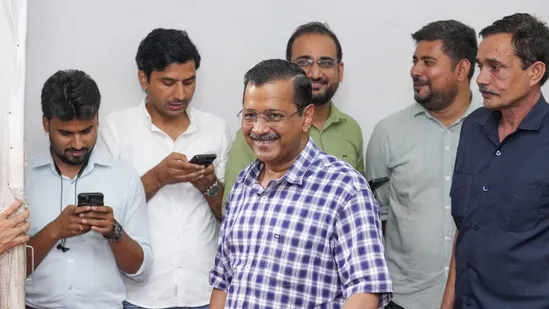
The Aam Aadmi Party (AAP) marked a significant political comeback by clinching two crucial assembly seats—Visavadar in Gujarat and Ludhiana West in Punjab—during recent by-elections. This electoral performance comes months after a disappointing showing in the Delhi Assembly polls and signals renewed voter confidence in AAP’s governance model. Party chief Arvind Kejriwal interpreted the victory as a clear sign of public dissatisfaction with the ruling Bharatiya Janata Party (BJP), especially in Gujarat. Kejriwal also dismissed speculation about his possible entry into the Rajya Sabha, reinforcing AAP’s institutional decision-making and broader strategic focus.
By-Election Triumph Revives AAP’s Political Momentum
The Aam Aadmi Party’s success in the latest round of by-elections has reignited its political standing, with the party securing victories in two out of five contested assembly seats. AAP candidates emerged victorious in the Visavadar constituency in Gujarat and Ludhiana West in Punjab—regions where the BJP and Congress have traditionally held sway.
The wins serve as a morale boost for AAP’s cadre and leadership, particularly after the party’s underwhelming performance in Delhi earlier this year. Both wins came with comfortable margins, reinforcing AAP’s growing appeal across regional lines and validating its political strategy beyond its traditional strongholds.
Kejriwal Attributes Win to Voter Fatigue with BJP
Speaking at a press conference, AAP national convener Arvind Kejriwal credited the victories to growing public discontent with the BJP’s governance, particularly in Gujarat. “Despite the BJP's grip on the administration and its conventional stronghold in Gujarat, voters chose AAP by a double margin,” he said, describing the outcome as a rejection of political status quo.
The Visavadar constituency was previously won by AAP in the February elections, but its MLA defected to the BJP—an episode Kejriwal alluded to in his remarks. The party’s ability to reclaim the seat, he said, illustrates public rejection of political opportunism and support for AAP’s ideological consistency.
Denies Personal Bid for Rajya Sabha Seat
Amid speculation that Kejriwal might replace Sanjeev Arora—AAP’s Rajya Sabha MP who won the Ludhiana West seat—he firmly dismissed the notion. “I am not going to the Rajya Sabha. The Political Affairs Committee will decide the nominee,” Kejriwal said, emphasizing that decisions would be taken collectively and strategically, not personally.
This statement comes in response to opposition claims that the by-election result was engineered to facilitate Kejriwal’s entry into the Upper House. His rejection of the idea reflects a calculated move to maintain focus on organizational stability and state-level political consolidation.
Political Jabs at Congress and BJP
Kejriwal also intensified his rhetoric against both the Congress and BJP, accusing the former of playing a proxy role in ensuring BJP’s victories. “Congress is working as a puppet for the BJP in Gujarat,” he said, calling on disillusioned Congress members to join AAP and engage in what he framed as the only real opposition to BJP dominance.
These remarks are part of AAP’s larger strategy to position itself as the principal national alternative, especially in states where traditional opposition parties have lost electoral traction. By portraying the Congress as complicit, AAP aims to capture a larger anti-BJP constituency in upcoming elections.
Implications for AAP’s National Expansion
The by-election results have broader implications for AAP’s national expansion plans. The wins in Gujarat and Punjab highlight the party’s ability to penetrate diverse political landscapes and challenge entrenched political establishments.
Moreover, with Sanjeev Arora vacating his Rajya Sabha seat after winning the Ludhiana West assembly seat, the party has the opportunity to strategically place a new voice in the Upper House—one that aligns with its legislative agenda and expansion goals.
Kejriwal’s decision to stay out of the Rajya Sabha also sends a message that he remains committed to grassroots mobilization and electoral politics, rather than seeking influence through parliamentary positioning.
Conclusion: A Recharged Opposition Force
AAP’s performance in the by-elections signals more than just electoral gains; it marks a shift in political energy. The party is actively reshaping opposition dynamics in states like Gujarat while reaffirming its hold in Punjab. By distancing itself from internal speculation and focusing on institutional decision-making, AAP is strengthening its image as a disciplined, expanding political force ready to fill the vacuum left by traditional players.
Comments