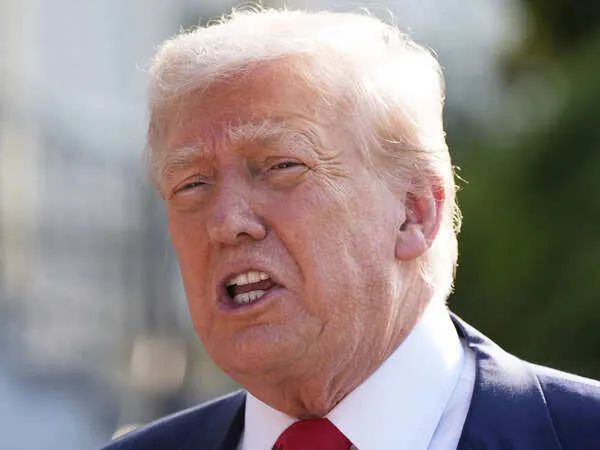
Former U.S. President Donald Trump recently asserted that Japan will invest a staggering Rs. 45.8 lakh crore (approximately $550 billion) into the American economy, attributing the decision to his influence. The claim, made during a public address, sparked intrigue and skepticism across economic and diplomatic circles, as no official confirmation or documentation has emerged from Tokyo. While Japanese firms have historically maintained strong investment ties with the U.S., experts caution that such an ambitious figure may be more aspirational than concrete. The statement raises questions about political positioning, global trade dynamics, and the future of bilateral economic relations.
---
The Claim: A Monumental Investment Announcement
During a recent campaign-style speech, Donald Trump declared that Japan would be investing $550 billion into the United States “at his behest.” The claim, delivered with characteristic bravado, appeared aimed at reinforcing Trump’s economic credentials and his perceived sway over global partners.
Though the former president offered no detailed breakdown of the proposed investment—whether it would be government-led, private sector-driven, or a mix of both—the magnitude of the figure naturally drew widespread attention. For context, the number represents more than 10% of Japan’s annual GDP and exceeds the combined foreign direct investment (FDI) into the U.S. from all countries in some recent years.
---
Japan’s Investment Track Record in the U.S.
Japan has long been a major investor in the United States, particularly in the automotive, technology, and real estate sectors. According to past FDI reports, Japanese companies have consistently poured billions into American operations, supporting jobs, innovation, and manufacturing hubs across multiple states.
In 2022, for example, Japan’s total direct investment position in the U.S. stood at over $700 billion—an accumulation of decades of capital flows, mergers, acquisitions, and greenfield investments. However, a new injection of $550 billion, especially as a singular policy shift, would represent an unprecedented move in the history of bilateral economic ties.
---
Political Messaging or Policy Reality?
Analysts and trade experts have urged caution in interpreting Trump’s statement as definitive policy or a binding agreement. Without corroboration from Japanese government officials or corporate leadership, such declarations are often seen as rhetorical positioning, especially in an election cycle where economic nationalism is a key theme.
Some observers speculate the figure could be a cumulative target discussed informally with Japanese executives, while others view it as a symbolic gesture intended to project strength in foreign economic diplomacy. The absence of concrete terms or a formal roadmap further complicates efforts to validate the claim.
---
Japan’s Economic Strategy: Global Diversification, Not Concentration
From Tokyo’s perspective, Japan’s global investment strategy emphasizes diversification rather than concentration in any single market. While the United States remains a preferred destination due to its stable regulatory environment and consumer base, Japanese firms are also actively investing across Southeast Asia, India, and Europe.
Furthermore, Japan’s cautious fiscal outlook, aging population, and focus on domestic resilience suggest that any large-scale outbound capital commitment would undergo rigorous internal scrutiny. Experts argue that any move to channel half a trillion dollars into one country—regardless of alliance strength—would require a multi-year, multi-sectoral strategic framework.
---
Broader Implications for U.S.–Japan Economic Relations
Whether or not Trump’s $550 billion claim materializes, it has rekindled debate on the scope and direction of U.S.–Japan economic relations. Trade between the two countries remains robust, underpinned by mutual interests in semiconductors, electric vehicles, defense manufacturing, and infrastructure.
Both governments have also shown interest in deepening supply chain integration and technological cooperation, particularly in response to growing tensions with China. These factors could result in elevated Japanese investment in the U.S.—though on a scale and timeline far more conservative than the figure Trump proposed.
---
Conclusion
Donald Trump’s pronouncement that Japan will invest Rs. 45.8 lakh crore in the United States underscores the fusion of politics and economic spectacle. While the claim lacks official backing and raises more questions than answers, it serves as a reminder of how high-profile leaders often shape economic narratives with bold, if unverified, declarations. Investors and policymakers alike would be wise to separate the rhetoric from reality as the global economic order continues to shift.
Comments