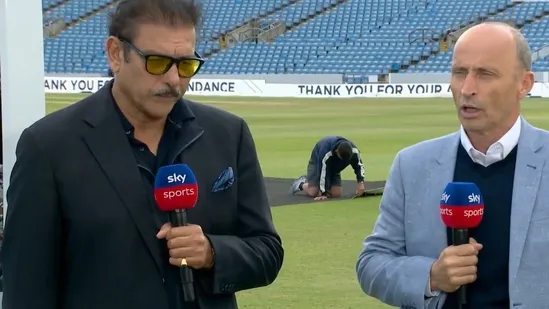
India’s loss in the opening Test against England at Headingley has ignited a fresh round of introspection around leadership and team balance. Former England captain Nasser Hussain echoed Ravi Shastri’s concerns about Shubman Gill’s lack of tactical command, questioning the young skipper's reactive approach in a high-pressure debut. Hussain also reignited discussions around India's long-standing struggle to find a seam-bowling all-rounder—emphasizing the void left by players like Hardik Pandya. Despite notable individual performances, India’s lower-order collapse, defensive captaincy, and tactical missteps allowed England to chase down 371 with alarming ease.
A Leadership Void in the Making?
The Test match in Leeds, which marked Shubman Gill’s captaincy debut following Rohit Sharma’s retirement, was not merely a statistical setback—it opened a Pandora’s box of leadership questions for Indian cricket. England’s successful chase of 371, their second-highest at home, exposed more than just frailties in execution; it revealed a lack of clarity and command on the field.
Former England skipper Nasser Hussain, speaking on Sky Cricket, noted that Gill’s leadership lacked the distinctive aura associated with his predecessors. “He didn’t quite have that on-field presence that you saw with Kohli or Rohit. I saw someone still finding his feet, and the decisions looked more reactive than proactive,” Hussain remarked.
According to Hussain, Gill appeared to rely heavily on his senior teammates—Rishabh Pant and KL Rahul—resulting in a fragmented command structure, described as “captaincy by committee.” While expected in a debut, the inconsistency in tactical response allowed England to dominate the narrative by Day 5.
The Jadeja Miscalculation: A Missed Opportunity
One of the more glaring tactical errors, as highlighted by both Hussain and Shastri, was the underutilization of spin-friendly conditions. Ravindra Jadeja bowled without exploiting the rough areas on a Day 5 pitch that could have turned the tide. “There was no clear directive to Jadeja to bowl into the rough. Ravi [Shastri] and Mark Butcher were in the box saying, ‘pitch it wider,’ but it never happened,” Hussain explained.
Despite Jadeja’s experience, he returned figures of 1 for 104, raising eyebrows over the absence of intervention from the captain or senior players. The communication gap on the field, especially in leveraging favorable pitch conditions, highlighted deeper structural issues in decision-making.
Hardik Pandya’s Absence Still Looms Large
India’s search for a dependable seam-bowling all-rounder remains unresolved—a strategic deficiency that re-emerged starkly in Leeds. The management’s attempt to fill the void with Shardul Thakur and Nitish Reddy failed to yield the desired balance, as the team’s lower-order collapsed in both innings despite five centuries from the top order.
Hussain pointedly referenced India’s continued inability to replace the all-round capabilities of Hardik Pandya, or before him, legends like Kapil Dev. “The collapses are worrying. Seven for 41, six for 30—this is unsustainable. India needs someone who can hold the bat at No. 7 or 8 and bowl 10 good overs in a Test,” Hussain asserted.
While the Indian team has thrived for years on the depth provided by spin-bowling all-rounders like Ashwin, Jadeja, and Axar Patel, English conditions demand a different toolkit—one they are yet to refine.
Slip-Ups in the Slips and Fielding Concerns
India’s struggles weren’t confined to tactical and personnel choices. Hussain also underscored the deterioration of slip fielding—an area that had been a relative strength in recent years. The lapses in catching and coordination further compounded the team’s woes and undermined otherwise competitive totals.
These seemingly minor errors, when aggregated, contributed significantly to the match slipping out of India’s grasp despite being well-poised on several occasions.
Looking Ahead: Urgency for Structural and Strategic Realignment
As India trails 0–1 in the five-Test series, the questions loom large: Can Shubman Gill evolve quickly into a decisive leader? Will India find the seam-bowling all-rounder they so critically lack? And can the team address its lower-order fragility before the series spirals out of control?
While individual brilliance is never in short supply in Indian cricket, the Leeds loss has underscored the importance of leadership clarity, tactical maturity, and structural depth—elements that require immediate attention if India is to mount a serious comeback.
Comments