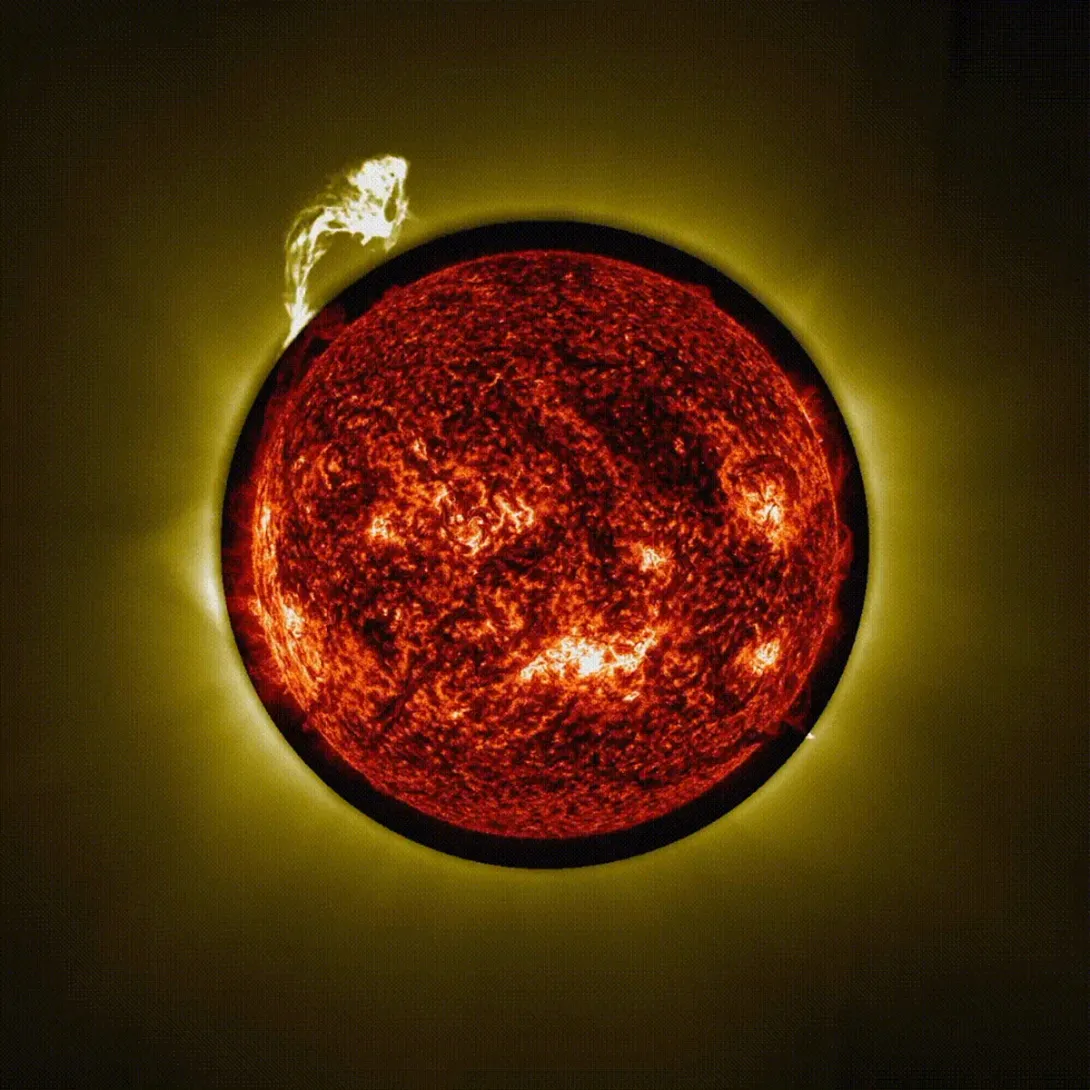
Proba-3, an advanced space mission led by the European Space Agency, is redefining how satellites operate together in orbit. Designed as a dual-spacecraft system, Proba-3 will demonstrate ultra-precise formation flying, allowing two satellites to function as a single scientific instrument. The mission’s primary objective is to observe the Sun’s corona with unprecedented clarity by creating an artificial solar eclipse in space. Beyond its scientific goals, Proba-3 represents a major technological leap, with far-reaching implications for future space missions, satellite servicing and large-scale orbital observatories.
Mission Overview and Objectives
Proba-3 consists of two small satellites flying in exact formation, separated by approximately 150 meters, with millimeter-level precision. One spacecraft carries a coronagraph, while the other acts as an occulter, blocking direct sunlight to enable detailed observation of the Sun’s outer atmosphere.
This coordinated design allows scientists to study the solar corona for extended periods—something not possible with natural eclipses or traditional single-satellite missions.
Technological Breakthrough in Formation Flying
At the heart of Proba-3 is autonomous formation-flying technology, which enables the satellites to maintain precise relative positions without continuous ground intervention. Advanced sensors, laser-based metrology and onboard AI-driven navigation systems work together to achieve this accuracy.
Experts view this capability as a critical milestone, opening the door to future missions involving modular spacecraft, distributed telescopes and in-orbit assembly.
Scientific Value and Solar Research
The mission’s solar observations are expected to deepen understanding of coronal heating and solar wind generation—phenomena that directly influence space weather. Improved insights could enhance forecasting of solar storms that affect satellites, power grids and communication systems on Earth.
By extending observation times from minutes to several hours, Proba-3 provides a richer dataset for heliophysics research.
Strategic Importance for the Space Industry
Beyond science, Proba-3 serves as a technology demonstrator with commercial and strategic relevance. Formation flying is increasingly seen as essential for next-generation Earth observation, defense and deep-space exploration missions.
Space analysts note that such missions strengthen Europe’s position in advanced satellite technologies, an area of growing global competition.
Looking Ahead
Proba-3 signals a shift toward collaborative spacecraft architectures, where multiple satellites operate as a unified system. If successful, the mission will influence how future space infrastructure is designed and deployed.
As space agencies and private players pursue more complex and ambitious missions, Proba-3 stands out as a quiet but transformative step—proving that precision, autonomy and coordination will define the next chapter of space exploration.
Comments