The cryptocurrency market is experiencing a risk-off sentiment, as escalating geopolitical tensions between Israel and Iran weigh heavily on investor sentiment. Bitcoin (BTC), which had seen a brief recovery earlier in the week, is now trading lower, hovering near $102,000. Altcoins such as Ethereum (ETH), Solana (SOL), and Dogecoin (DOGE) have also seen significant losses, with some lesser-known tokens like Fartcoin (FARTCOIN) and Ethena (ENA) pulling back by as much as 20%. With bearish indicators in play, the market faces potential further declines, particularly if Bitcoin fails to hold key support levels.
Geopolitical Uncertainty Drives Cryptocurrency Sell-Off
On Friday, global markets were rattled by heightened tensions following Israel's confirmation of attacks on Iran's nuclear facilities. As investors braced for potential repercussions in the global economy, the cryptocurrency market was not immune to the broader risk-off sentiment. Bitcoin (BTC), which had briefly gained momentum earlier in the week, is now seeing a pullback, edging lower by nearly 2%.
This retreat is not isolated to Bitcoin alone. Ethereum (ETH), Solana (SOL), and Dogecoin (DOGE) have all witnessed declines of nearly 10% within a 24-hour period. Even smaller altcoins like Fartcoin (FARTCOIN) and Ethena (ENA) have suffered substantial losses, falling by around 20% during the same timeframe.
Bitcoin’s Struggle: Testing Critical Support Levels
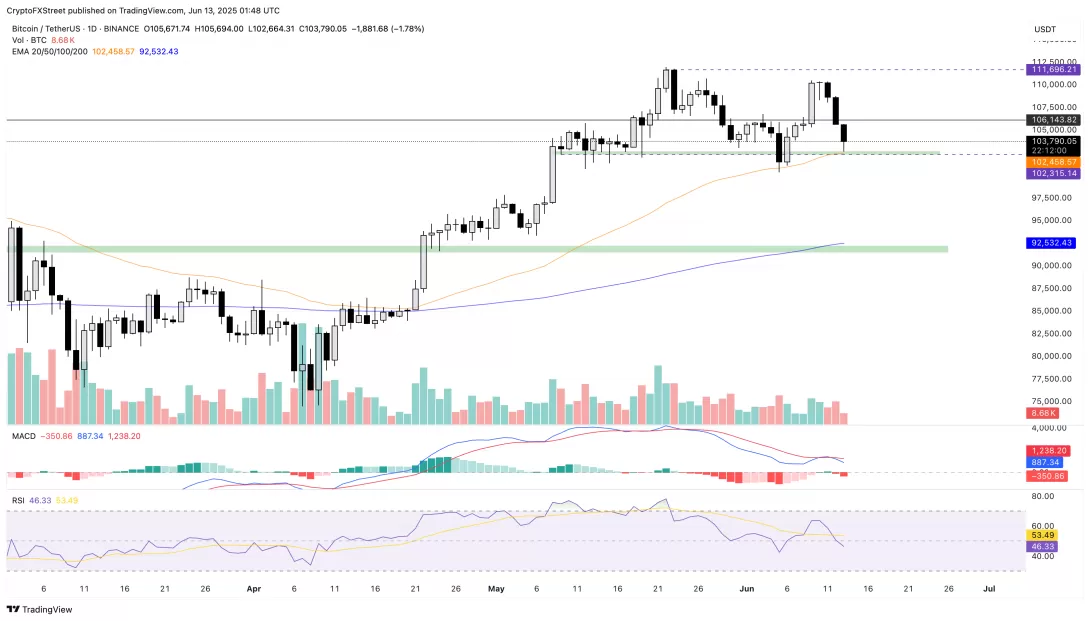
Bitcoin's price action paints a grim picture, as the market leader struggles to maintain its footing. At press time, Bitcoin briefly dropped below the $103,000 mark, touching $102,664. This price movement erases the gains made earlier this week, with the cryptocurrency down almost 2% for the week.
Despite the current bearish momentum, Bitcoin has found some support in the $102,000–$103,000 range, as well as at the 50-day Exponential Moving Average (EMA), which is currently positioned at $104,458. The green band on the chart marks a high-demand zone, which has offered some resilience for BTC. However, the bearish candle patterns suggest that the downward pressure may continue.
Bearish Indicators Suggest Further Downside
A deeper analysis of Bitcoin’s technical indicators provides a more cautionary outlook. The Moving Average Convergence/Divergence (MACD) has failed to generate a bullish reversal, as the indicator reversed from its signal line without crossing above it. The resurgence of bearish histograms suggests that a pullback phase is likely to persist in the short term.
Additionally, the Relative Strength Index (RSI), currently at 45, is well below the neutral 50 level, indicating a loss of bullish momentum. As the RSI edges closer to the oversold zone, there is a risk of further downside for Bitcoin and the broader cryptocurrency market.
Potential Bearish Scenarios and Support Levels
If Bitcoin closes below the critical 50-day EMA level at $104,458, it could signal a violation of the support zone above $102,000. In such a scenario, Bitcoin may target the next immediate support level at $100,372, which corresponds to the 30-day lowest trading price. This level could act as a potential entry point for sidelined investors seeking to re-enter the market.
Conclusion: Geopolitical Factors Add Uncertainty to Market Sentiment
The cryptocurrency market remains volatile, with geopolitical tensions and technical indicators suggesting further downside in the short term. While Bitcoin holds some support at the $102,000–$103,000 zone, a breach of the 50-day EMA could open the door for more significant declines. For altcoins, the broader market sentiment is also a concern, with many coins experiencing heavy sell-offs.
As the situation in the Middle East unfolds, investors will need to closely monitor Bitcoin’s performance and any potential impact on broader financial markets. For now, cautious optimism seems to be giving way to a more risk-averse approach, with traders bracing for further volatility.
Comments