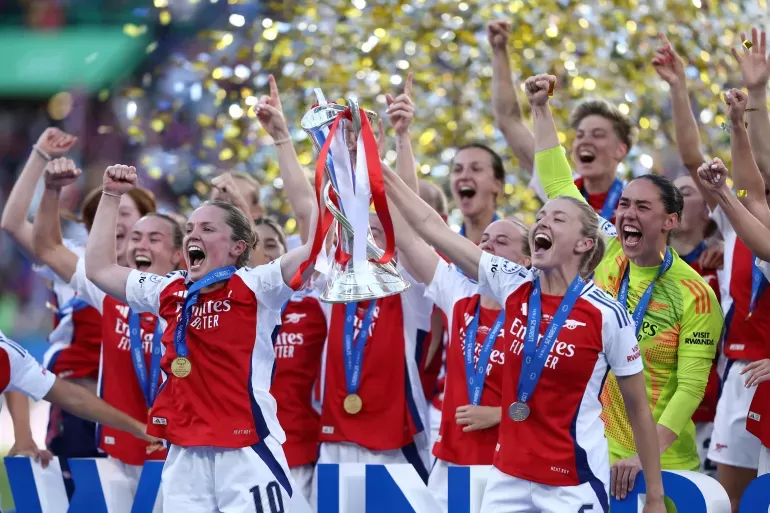
Arsenal Women scripted a historic triumph in Lisbon by defeating reigning champions Barcelona 1-0 in the UEFA Women’s Champions League final, ending an 18-year wait for Europe’s most prestigious club title. Substitute Stina Blackstenius scored the decisive goal in the 75th minute, capitalizing on an assist from Beth Mead. The win marks Arsenal’s second European crown, making them the only English women’s club to achieve this feat. Overcoming pre-match odds and Barcelona’s dominant form, Arsenal’s resilient defence and strategic pressing defined the contest, sealing a legacy-defining victory in a season of transformation and tenacity.
Arsenal Ends Barcelona’s Reign in Lisbon
In a tightly contested final at Estadio José Alvalade in Lisbon, Arsenal defied expectations to upset Barcelona, the tournament’s heavy favourite, and secure their second Women’s Champions League title. The London club’s previous triumph came in 2007, and Saturday’s result etched a new chapter in European football history, not only for Arsenal but also for English women’s football.
Arsenal’s match-winning goal came in the 75th minute when Swedish striker Stina Blackstenius calmly finished a move orchestrated by Beth Mead—both of whom had been introduced as substitutes in the second half. The tactical shift paid immediate dividends, shifting momentum decisively in Arsenal’s favor.
An Underdog Triumph Against Europe’s Elite
Barcelona, featuring a star-studded lineup that included two-time Ballon d’Or winners Aitana Bonmatí and Alexia Putellas, entered the final with momentum, chasing a fourth title in five years and hoping to become the second team after Lyon to win three consecutive titles. The Catalan giants had dismantled Wolfsburg and English champions Chelsea in the earlier rounds, arriving in Lisbon as overwhelming favorites.
However, Arsenal’s tactical discipline, particularly their high press and compact midfield, effectively neutralized Barcelona’s signature possession-based play. Arsenal managed to limit Barcelona’s opportunities, despite an early second-half surge that saw Claudia Pina hit the crossbar and Bonmatí force a low save from goalkeeper Daphne van Domselaar.
A Season Redeemed Under New Leadership
This European triumph comes as a remarkable turnaround in what had been a turbulent season for Arsenal. Head coach Jonas Eidevall resigned mid-season, prompting the elevation of assistant coach Renee Seglers. Under Seglers’ stewardship, Arsenal underwent a tactical evolution, building confidence through dramatic knockout stage victories over Real Madrid and record eight-time champions Lyon.
The win against Barcelona capped a resurgent European campaign, marked by defensive solidity and strategic counter-attacks. Seglers’ ability to unify and reinvigorate the squad was instrumental in transforming Arsenal from underachievers into European champions.
Defining Performances from a United Squad
Throughout the final, Arsenal’s players demonstrated composure, physicality, and a collective will to win. Alessia Russo, leading the line with tenacity, disrupted Barcelona’s rhythm by winning aerial duels and holding up play. Frida Maanum posed a persistent threat from midfield, while Leah Williamson anchored the backline with a commanding presence, notably blocking a goal-bound strike from Bonmatí early in the match.
Though Arsenal thought they had taken the lead in the 22nd minute via an own goal by Irene Paredes, a VAR review ruled it out for offside. Undeterred, Arsenal pressed on, with Maanum nearly scoring minutes later, only to be denied by Barcelona goalkeeper Cata Coll.
Blackstenius had earlier been thwarted by a sharp save from Coll in the 72nd minute after intercepting a loose pass. But just three minutes later, she made no mistake—slotting home the winning goal and igniting wild celebrations from the Arsenal bench and their travelling supporters.
Barcelona Left Searching for Answers
For Barcelona, the defeat was a rare setback in an otherwise dominant era. Despite dominating possession for stretches and registering several close chances, the Spanish side was unable to crack Arsenal’s defensive setup. Their fans, who heavily outnumbered the red-and-white contingent in Lisbon, remained vocal until the final whistle, but their chants of “Yes we can!” were ultimately in vain.
Speaking after the match, Bonmatí offered an apology to supporters:
“We are very sorry for all our fans who have come to support us. We will try to do it again.”
Conclusion: A Victory Beyond the Scoreline
Arsenal’s triumph in Lisbon was more than a football match—it was a story of resilience, strategy, and unity. In defeating a Barcelona side that had redefined dominance in European women’s football, Arsenal not only reclaimed their place among the continent’s elite but also reignited hope and ambition across English women’s football.
With a new coaching vision, a balanced squad, and belief forged through adversity, Arsenal’s victory stands as a symbol of what can be achieved when preparation meets purpose. As the confetti settled over the Estadio José Alvalade, it was clear: Arsenal are champions once more, and their European legacy is far from finished.
Comments