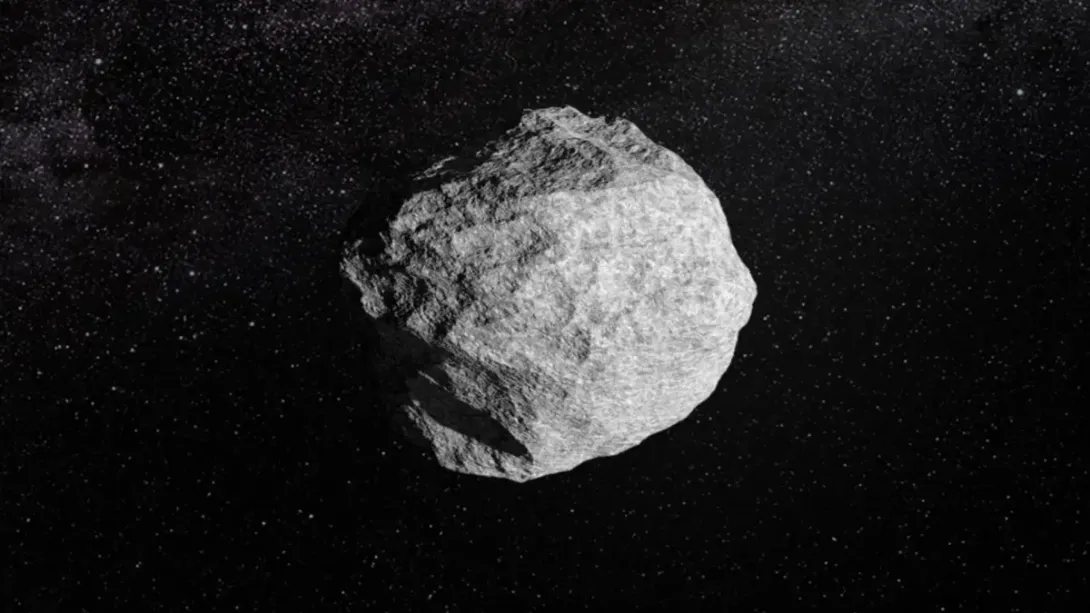
Astronomers are closely monitoring a recently discovered near-Earth object, Asteroid 2024 YR4, after calculations suggested a possible collision with the Moon in 2032. While early assessments indicate no immediate threat to Earth, scientists are studying the asteroid’s trajectory, velocity, and gravitational interactions to refine predictions. The celestial body, roughly 90 to 120 meters wide, could produce a significant lunar impact if it stays on its projected path. NASA and international observatories are now conducting long-term tracking to determine the likelihood of a strike — a rare event that could offer unprecedented scientific insight into lunar geology and asteroid behavior.
Discovery and Initial Assessment
Asteroid 2024 YR4 was first detected late last year by NASA’s Pan-STARRS observatory in Hawaii during a routine sky survey aimed at cataloging potentially hazardous near-Earth objects (NEOs). Subsequent observations confirmed that the asteroid follows a highly elliptical orbit intersecting the orbital path of both Earth and its Moon.
Based on preliminary models from NASA’s Center for Near-Earth Object Studies (CNEOS), the asteroid’s orbital period is estimated at 2.8 years, suggesting that it makes regular passes through the inner solar system. Its most notable future approach is predicted for mid-2032, when gravitational interactions with Earth could slightly alter its trajectory — possibly steering it toward the lunar surface.
The Potential Impact on the Moon
Should Asteroid 2024 YR4 collide with the Moon, the event would not pose a direct danger to Earth, but the impact could still be scientifically significant. With an estimated diameter exceeding 100 meters, the asteroid could carve a crater nearly 1 kilometer wide, depending on the angle and velocity of impact.
NASA’s Lunar Reconnaissance Orbiter (LRO) and the upcoming Artemis lunar missions may provide vital data to study such an impact site, should it occur. Scientists believe the collision could offer a rare natural experiment — allowing researchers to analyze subsurface materials and seismic effects on the Moon’s crust, providing deeper insights into its geological evolution.
Current Risk Assessment and Orbital Dynamics
Experts emphasize that asteroid trajectories are highly sensitive to gravitational perturbations from planets, solar radiation pressure, and even minor outgassing events. These factors can shift an asteroid’s orbit over time, sometimes by thousands of kilometers.
Dr. Ananya Patel, a planetary scientist with the Indian Institute of Space Science and Technology (IIST), noted that the Moon’s weaker gravitational pull makes it more vulnerable to minor orbital deviations of passing asteroids. “Unlike Earth, the Moon lacks a protective atmosphere and experiences impacts far more frequently. However, collisions of this scale are still exceptionally rare,” she explained.
NASA’s CNEOS currently classifies 2024 YR4 as a Potentially Hazardous Object (PHO) — not due to an imminent threat, but because of its close approach distances and size threshold.
International Collaboration and Tracking Efforts
To refine orbital predictions, NASA has partnered with international observatories, including the European Space Agency’s Near-Earth Object Coordination Centre (NEOCC) and the Indian Space Research Organisation (ISRO). These institutions are contributing telescope time and computational models to enhance long-term tracking precision.
In addition, radar observations from NASA’s Goldstone Deep Space Communications Complex and the Arecibo substitute facilities are expected to provide detailed measurements of the asteroid’s spin rate, composition, and reflectivity. This data will help scientists model how non-gravitational forces — such as the Yarkovsky effect, where heat from sunlight alters an asteroid’s orbit — could influence its future trajectory.
Lessons from Past Encounters
While the prospect of an asteroid striking the Moon sounds dramatic, similar events have occurred before. In 2019, a small meteorite impact was captured during a lunar eclipse, creating a bright flash visible from Earth. More recently, in 2022, a spent rocket stage collided with the Moon, offering valuable seismic data for researchers.
However, an asteroid the size of 2024 YR4 would represent a far larger impact — comparable to a 100-megaton explosion, though the Moon’s lack of atmosphere would limit ejecta dispersal. The resulting crater and debris plume could still be observed by telescopes and orbiters, contributing to our understanding of impact physics and crater formation.
Scientific Opportunities Ahead
If predictions hold, the potential collision presents a rare opportunity for planetary scientists. Lunar impacts of this magnitude are seldom witnessed in real time, and coordinated observations could help refine models of impact mechanics, seismic propagation, and ejecta distribution.
NASA and ISRO are also considering pre-impact monitoring campaigns to capture high-resolution imagery before and after the event. The resulting data could inform not only lunar science but also planetary defense strategies, offering insight into how celestial bodies respond to kinetic impacts — a key factor in developing asteroid deflection techniques for Earth.
Conclusion
As Asteroid 2024 YR4 continues its silent voyage through space, scientists remain cautiously optimistic. The likelihood of a direct lunar impact in 2032 remains low but not negligible, warranting continued monitoring and data collection.
Beyond its potential for spectacle, the event underscores the importance of planetary defense and inter-agency cooperation in tracking near-Earth objects. Whether or not 2024 YR4 strikes the Moon, the research it inspires will deepen humanity’s understanding of the dynamic environment that shapes our solar system — and remind us of how even distant celestial bodies remain intricately connected to our own.
Comments