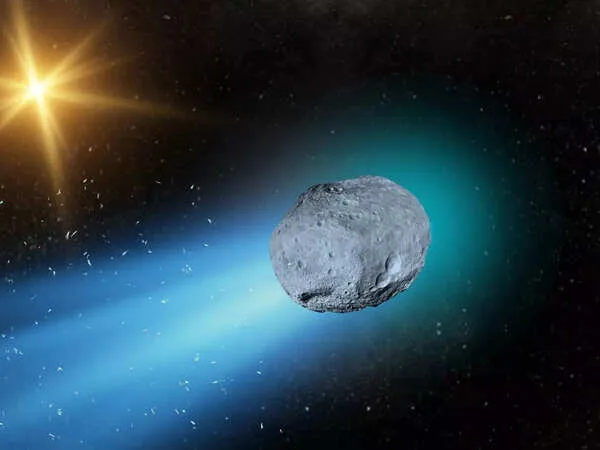
The astronomical community and space enthusiasts worldwide have been abuzz with speculation over NASA’s continued silence regarding 3I/ATLAS, the second-known interstellar object to pass through our solar system. Despite confirmed observations and data collection, the agency has yet to release high-resolution images of this rare celestial body. The lack of visual evidence has led to growing curiosity and concern, with many questioning the reasons behind the delay. Scientists suggest the answer may lie not in secrecy but in science itself — from technical limitations to data integrity and prioritization of other missions.
---
Understanding 3I/ATLAS: A Visitor from Beyond the Solar System
3I/ATLAS, first detected in 2019, is only the second interstellar object ever discovered — following the much-discussed ‘Oumuamua in 2017. Unlike typical comets, 3I/ATLAS originated outside our solar system, entering with a trajectory and velocity inconsistent with any known planetary orbit.
Initial observations revealed an elongated, comet-like structure emitting faint traces of gas and dust, suggesting it carried volatile materials despite its long interstellar journey. Astronomers were quick to capture spectral data, but direct, high-definition imaging has remained elusive. The comet’s rapid movement, distance from Earth, and dim luminosity have all posed significant challenges to obtaining detailed photographs.
---
Technical Challenges Behind the Missing Images
NASA’s silence on high-resolution imagery may stem primarily from observational limitations. The comet’s path through the inner solar system was both brief and distant, giving telescopes minimal time to gather clear visual data. Even with powerful instruments such as the Hubble Space Telescope and ground-based observatories, 3I/ATLAS was positioned at an angle that made capturing reflective light nearly impossible.
Additionally, data calibration and verification take months or even years. High-resolution space imaging is not a simple snapshot process — it involves filtering cosmic noise, correcting distortions, and merging thousands of data frames. NASA’s priority is scientific accuracy, and releasing incomplete visuals could misrepresent the object’s true nature.
---
Strategic Priorities and the Question of Secrecy
While conspiracy theories have inevitably circulated online, experts emphasize that NASA’s silence likely reflects institutional caution, not concealment. The agency often delays public releases until peer-reviewed results are ready. At the same time, NASA’s resources are heavily allocated toward ongoing missions such as Artemis, the James Webb Space Telescope’s exoplanet research, and Mars exploration — all of which carry higher immediate scientific returns.
In this context, interstellar objects, though rare, are often relegated to secondary observation status unless they present a significant anomaly. NASA’s communications strategy prioritizes verified data, meaning any premature release could risk misinformation or public misunderstanding of the findings.
---
The Scientific Significance of 3I/ATLAS
Despite limited imagery, 3I/ATLAS holds immense scientific value. It represents a tangible link between our solar system and distant planetary systems, offering insights into how other stars form and evolve. By analyzing the object’s composition, researchers can better understand the chemical diversity of the galaxy — potentially identifying shared materials that suggest a universal blueprint for planet formation.
Moreover, studying 3I/ATLAS helps refine our detection capabilities for future interstellar visitors. Instruments like the Vera C. Rubin Observatory, set to begin operations soon, are expected to dramatically increase our ability to spot such fleeting cosmic travelers in real time.
---
Conclusion: Silence Now, Revelations Later
While NASA’s reluctance to release high-resolution images of 3I/ATLAS has sparked intrigue, the reasons appear grounded in scientific prudence rather than secrecy. The technical constraints, data verification protocols, and shifting mission priorities collectively explain the agency’s cautious approach.
As analytical work continues behind closed doors, the silence may not last forever. When the processed imagery and findings finally emerge, they could offer humanity a rare glimpse into the vast, uncharted spaces between the stars — reaffirming that our cosmic neighborhood is far more interconnected than we ever imagined.
Comments