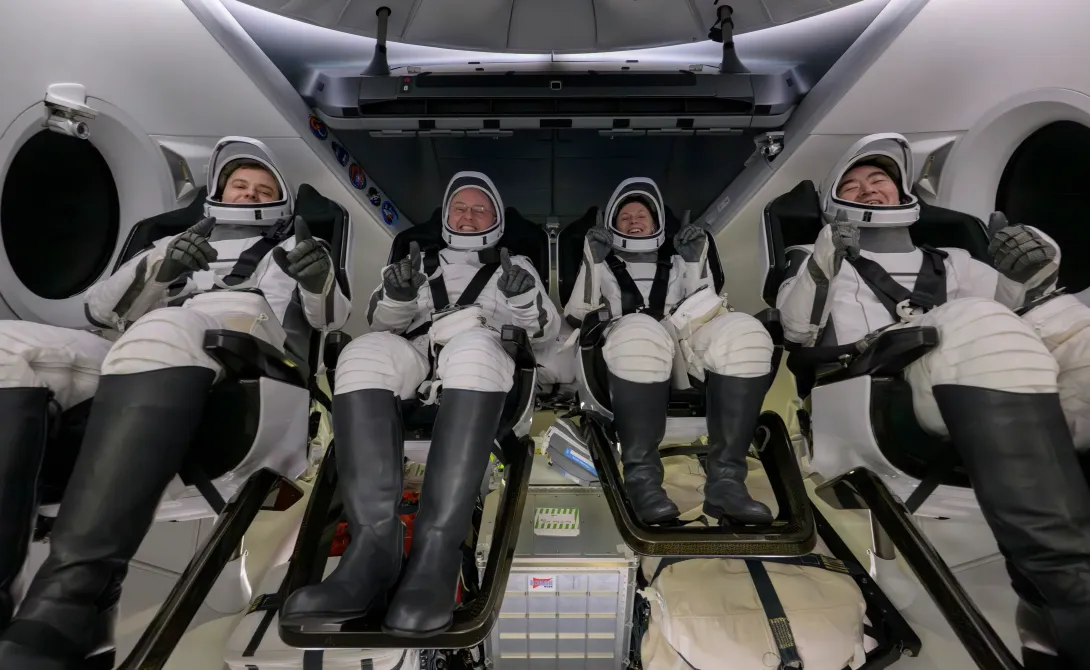
NASA has completed the safe return of its International Space Station (ISS) crew, marking the conclusion of another closely monitored orbital mission that underscored international cooperation and technological reliability in human spaceflight. The astronauts’ return followed a carefully sequenced undocking, re-entry and landing process designed to ensure crew safety and mission integrity. The operation highlights NASA’s continued focus on sustaining long-duration missions aboard the ISS while preparing for future deep-space exploration. For the global space community, the successful return reinforces confidence in proven spacecraft systems and operational discipline.
Mission Completion and Return Sequence
The ISS crew’s journey back to Earth began with a scheduled undocking from the space station, followed by a controlled deorbit burn that guided the spacecraft into Earth’s atmosphere. NASA confirmed that all phases of re-entry proceeded as planned, culminating in a safe landing within the designated recovery zone.
Such operations involve years of planning and real-time coordination between flight controllers, recovery teams and international partners.
Scientific and Operational Contributions
During their time aboard the ISS, the crew conducted a wide range of scientific experiments spanning microgravity research, human health, materials science and Earth observation. These studies contribute to advancements not only in space exploration but also in medical research and industrial applications on Earth.
NASA officials noted that long-duration missions continue to provide critical data for understanding how the human body adapts to extended periods in space.
International Collaboration at the Core
The ISS remains a flagship example of multinational cooperation, with NASA working alongside space agencies from Europe, Japan, Canada and Russia. The successful return of the crew reflects shared operational standards and a unified commitment to safety.
Despite evolving geopolitical dynamics, collaboration aboard the ISS has remained largely insulated, emphasizing science and exploration over terrestrial divisions.
Preparing for the Next Phase of Human Spaceflight
As NASA plans for missions beyond low-Earth orbit, including lunar exploration under the Artemis program, ISS missions play a foundational role. Lessons learned from crew operations, life-support systems and long-term habitation directly inform future spacecraft design and mission planning.
Industry analysts view each successful crew return as a validation of NASA’s incremental, risk-managed approach to expanding human presence in space.
Looking Ahead
With the crew safely back on Earth, focus now shifts to post-mission analysis and the preparation of subsequent expeditions. The ISS continues to serve as both a scientific laboratory and a proving ground for humanity’s next steps in space.
The latest return reinforces a simple but critical truth of modern spaceflight: progress is built on consistency, collaboration and the disciplined execution of complex missions.
Comments