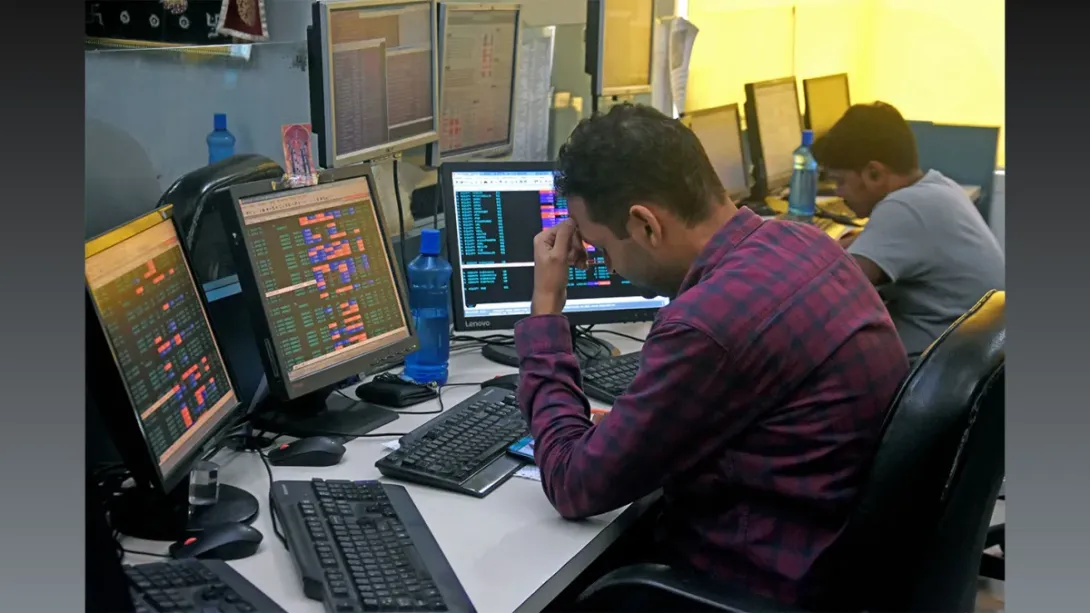
Indian equity markets witnessed a sharp sell-off, erasing Rs. 6.59 lakh crore in investor wealth in a single trading session as benchmark indices retreated under heavy selling pressure. Broad-based declines across banking, IT and capital goods stocks underscored fragile market sentiment amid global uncertainties and domestic valuation concerns. The downturn reflects heightened risk aversion among institutional investors and renewed volatility in emerging markets. Analysts attribute the correction to a combination of external headwinds, profit booking at elevated levels and cautious positioning ahead of macroeconomic triggers, reinforcing concerns about near-term stability in Indian financial markets.
Benchmark Indices Slide Amid Broad-Based Selling
Indian stock markets ended sharply lower, with benchmark indices registering significant intraday declines before closing deep in the red. The sell-off resulted in a staggering Rs. 6.59 lakh crore erosion in market capitalization, reflecting widespread liquidation across sectors.
The decline was not confined to a single pocket of the market. Heavyweights in banking, information technology, infrastructure and auto segments all faced selling pressure, signaling a systemic rather than isolated correction. Market breadth remained decisively negative, with a substantial majority of listed shares closing lower.
Such synchronized weakness typically indicates institutional repositioning rather than retail-driven volatility, suggesting that larger funds recalibrated exposure in response to macroeconomic signals.
Global Cues and Risk Aversion Weigh on Sentiment
Market participants cited adverse global cues as a key catalyst. Rising bond yields in developed markets, coupled with uncertainty around interest rate trajectories, have prompted foreign portfolio investors to reassess allocations to emerging economies such as India.
When global liquidity tightens, risk assets often face valuation compression. Emerging markets, despite strong structural growth narratives, are particularly vulnerable to capital outflows during periods of global monetary tightening.
In addition, persistent geopolitical tensions and commodity price fluctuations have injected fresh uncertainty into investor decision-making, dampening appetite for equities.
Domestic Valuations Under Scrutiny
While global developments played a role, domestic factors also contributed to the correction. Indian equities have traded at premium valuations relative to historical averages and regional peers, supported by robust earnings growth and sustained retail participation.
However, elevated price-to-earnings multiples leave limited margin for disappointment. Any indication of earnings moderation or macroeconomic headwinds can trigger swift profit booking, as witnessed in the latest session.
Analysts note that corrections of this magnitude often represent healthy consolidation after prolonged rallies, particularly when driven by valuation recalibration rather than structural deterioration.
Sectoral Impact: Financials and IT Lead Declines
Banking and financial services stocks bore the brunt of the downturn, given their significant weight in benchmark indices. Concerns around interest rate sensitivity and margin compression amplified selling pressure in these counters.
Information technology stocks also retreated, mirroring weakness in global tech markets. Given the sector’s export orientation, currency volatility and slowing demand in key Western markets remain critical risk variables.
Mid-cap and small-cap segments were not spared. In fact, the correction was sharper in certain mid-cap counters, reflecting higher beta sensitivity during periods of market stress.
Institutional Flows and Market Liquidity
Foreign institutional investors have exhibited fluctuating flow patterns in recent weeks, alternating between net buying and selling. Sustained outflows, even over short periods, can exert disproportionate pressure on headline indices due to concentrated holdings in large-cap stocks.
Domestic institutional investors, including mutual funds and insurance firms, have provided some counterbalance through steady inflows. However, during abrupt global risk-off phases, even domestic liquidity may struggle to fully absorb heavy foreign selling.
The interplay between global capital flows and domestic liquidity remains central to near-term market direction.
Is the Correction Structural or Cyclical?
Market corrections of this scale, while unsettling, are not unprecedented. Historically, Indian markets have demonstrated resilience, rebounding once macro uncertainties stabilize and earnings visibility improves.
The critical question is whether the current downturn signals a deeper structural slowdown or represents a cyclical pause within a broader growth trajectory. At present, economic fundamentals — including steady GDP growth, improving corporate balance sheets and strong tax collections — suggest the latter.
Nevertheless, volatility may persist in the short term as investors recalibrate expectations around global interest rates and domestic earnings growth.
The Road Ahead for Investors
For long-term investors, such drawdowns often present opportunities to accumulate quality assets at more reasonable valuations. However, prudent portfolio diversification and disciplined risk management remain essential.
The Rs. 6.59 lakh crore erosion in market capitalization underscores how swiftly sentiment can shift in modern financial markets. As liquidity dynamics and global macroeconomic signals continue to evolve, investors would be well advised to focus on fundamentals rather than short-term price movements.
In the final analysis, market volatility is an inherent feature of equity investing. The durability of India’s growth story will ultimately determine whether this correction becomes a footnote — or a turning point — in the broader financial narrative.
Comments