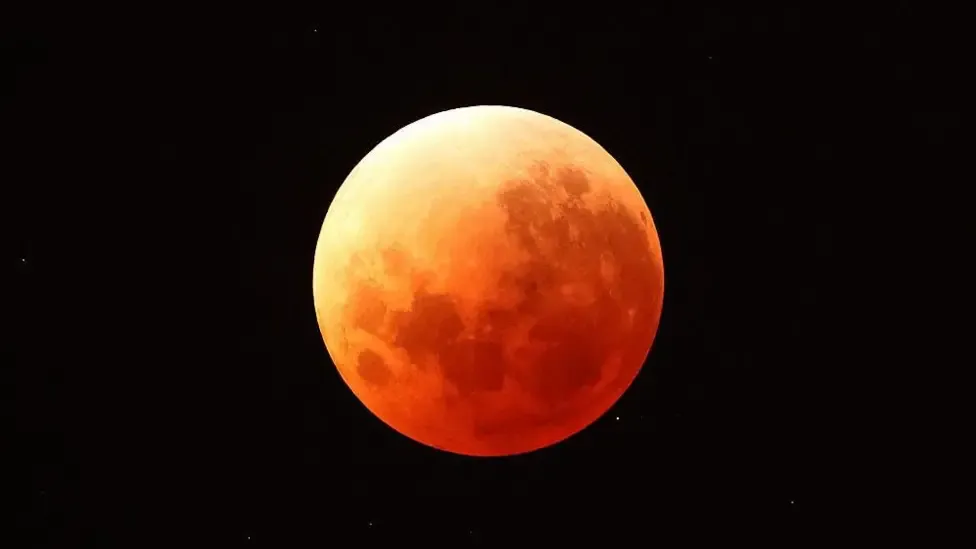
A striking celestial spectacle unfolded across North America as a dramatic “blood moon” lunar eclipse illuminated the night sky, drawing widespread attention from astronomers, skywatchers and scientific institutions. The phenomenon occurs when the Total Lunar Eclipse aligns the Earth, Moon and Sun, causing the Moon to appear deep red as sunlight filters through Earth’s atmosphere. The event triggered strong public engagement with astronomy while also generating valuable observational data for researchers. Experts note that such celestial events reinforce growing interest in space science, stimulate educational outreach and highlight the increasing role of astronomy in scientific communication and global curiosity about the universe.
A Celestial Event That Captured the Continent
Skywatchers across North America witnessed a rare and visually striking astronomical event as a Total Lunar Eclipse transformed the Moon into a glowing crimson sphere.
The phenomenon, commonly referred to as a “blood moon,” occurs when the Earth moves directly between the Sun and the Moon. During this alignment, Earth’s atmosphere bends sunlight and filters out shorter blue wavelengths, allowing red and orange hues to illuminate the lunar surface.
Observers from cities and rural regions alike reported clear views of the event, making it one of the most widely observed astronomical phenomena of the year.
The Science Behind the Blood Moon
The reddish glow associated with a blood moon is a direct result of atmospheric scattering. As sunlight passes through the outer edges of Earth’s atmosphere, dust, water vapor and atmospheric particles filter the light before it reaches the lunar surface.
Scientists describe the effect as similar to the way sunsets appear red on Earth. During a Total Lunar Eclipse, this atmospheric filtering becomes magnified, creating the distinctive crimson shade that gives the event its popular name.
Astronomers emphasize that each eclipse can appear slightly different depending on atmospheric conditions such as volcanic particles or pollution levels.
Public Engagement and Educational Impact
The eclipse generated significant interest among educational institutions and space agencies, which organized public viewing sessions and online broadcasts to engage audiences.
Astronomy clubs and science centers reported strong participation from students and amateur astronomers eager to observe the rare alignment. Such events often play an important role in stimulating curiosity about space science and encouraging young people to pursue studies in astrophysics and related disciplines.
Digital platforms also amplified the event, with images and time-lapse videos circulating widely across social media networks.
Scientific Opportunities for Researchers
Beyond its visual appeal, a Total Lunar Eclipse provides valuable opportunities for researchers studying Earth’s atmosphere and the Moon’s surface properties.
By analyzing the intensity and color variations of the eclipse, scientists can gather insights into atmospheric composition and the scattering behavior of sunlight. Observations of temperature changes and surface reflectivity on the Moon also contribute to ongoing lunar research.
These data points help refine scientific models related to planetary atmospheres and orbital mechanics.
Looking Ahead to Future Sky Events
Astronomers note that while lunar eclipses occur periodically, total eclipses visible across large geographic regions are less frequent. Observers in North America may need to wait several months or even years before witnessing a similarly dramatic blood moon.
Nevertheless, the recent event serves as a powerful reminder of the dynamic relationship between the Earth, Moon and Sun.
Comments