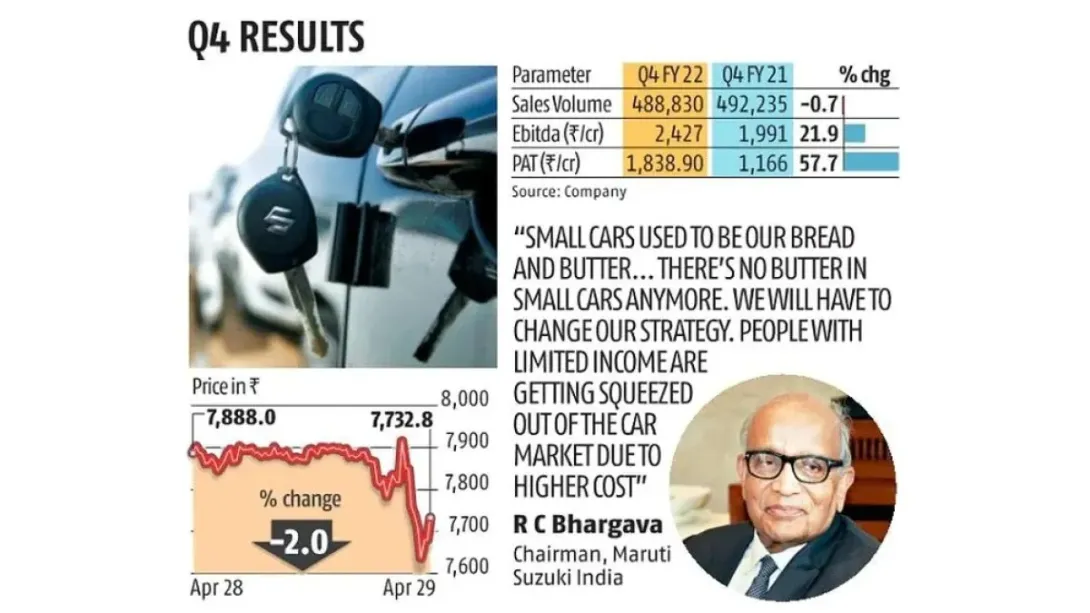
Maruti Suzuki Chairman R.C. Bhargava has underscored the pressing need for affordable small cars in India, positioning them as a practical alternative to two-wheelers for millions of first-time buyers. With rising incomes and urban mobility challenges, entry-level cars remain a critical bridge between motorcycles and full-fledged family vehicles. Bhargava argued that ensuring the availability of compact, low-cost cars is essential for expanding safe and efficient mobility access. However, regulatory costs, high taxation, and evolving consumer preferences have made it increasingly difficult for automakers to sustain production in the budget-car segment, threatening affordability for India’s middle and lower-income households.
The Case for Small Cars
India is the world’s largest two-wheeler market, with motorcycles and scooters serving as the primary mode of transport for most households. However, as families seek safer and more comfortable mobility, small cars provide the most viable upgrade.
Bhargava noted that without affordable entry-level cars, millions of two-wheeler owners will struggle to transition to four-wheelers, limiting both consumer welfare and automotive sector growth. Compact cars, he said, are not just an economic necessity but also a social one, given their role in improving safety, accessibility, and family mobility.
Affordability Challenges
The segment, however, faces structural hurdles. Over the past decade, rising input costs, stringent safety and emission regulations, and high goods and services tax (GST) rates have steadily pushed up car prices. What was once a Rs. 2–3 lakh entry point for new buyers has now climbed significantly, reducing affordability for large sections of the population.
Industry data suggests that sales of small cars have declined as buyers either delay purchases or shift to the used-car market. The shrinking of this segment has wider implications, as it was historically the foundation of India’s automobile revolution.
Policy and Industry Dynamics
Automakers argue that while stricter safety and environmental standards are necessary, policymakers must balance regulation with affordability. A calibrated tax structure, coupled with targeted incentives, could revive the small-car market and help automakers sustain production.
Bhargava emphasized that addressing this issue requires government-industry collaboration. If affordability challenges persist, India risks widening the mobility gap between two-wheeler and car ownership, undermining the sector’s long-term growth potential.
Looking Ahead
The chairman’s remarks highlight a critical policy dilemma: how to make mobility safer and more sustainable without pricing out aspiring middle-class consumers. As India accelerates toward electrification and modern mobility solutions, the relevance of affordable small cars remains undiminished.
For Maruti Suzuki, which built its legacy on accessible vehicles, the challenge is to balance innovation and compliance with the need to keep cars within reach of the average Indian household. The future of the small-car segment will depend on whether policymakers and manufacturers can jointly craft solutions that reconcile affordability with regulatory imperatives.
Conclusion
Maruti Suzuki’s call for renewed focus on small cars is a reminder that mobility in India is not just about premium models or electric vehicles—it is equally about enabling the average two-wheeler owner to make the transition to safer, more comfortable transport. The survival of the entry-level segment will be pivotal to India’s automotive growth story, and decisions made today will determine whether cars remain a realistic aspiration for millions of families.
Comments