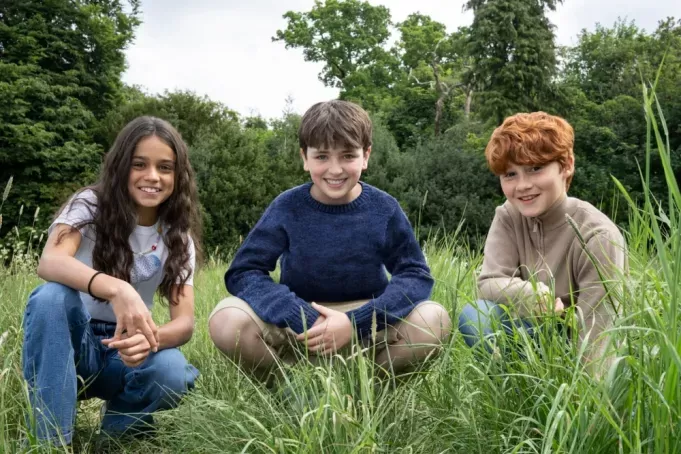
HBO has officially revealed the lead cast for its much-anticipated Harry Potter television series, selecting newcomers Dominic McLaughlin, Arabella Stanton, and Alastair Stout to portray the iconic trio of Harry, Hermione, and Ron. Chosen from a staggering pool of over 30,000 hopefuls, the young actors will begin filming this summer. This new adaptation marks a bold reimagining of J.K. Rowling’s globally celebrated saga, under the stewardship of showrunner Francesca Gardiner and director Mark Mylod. With high-profile co-stars and substantial backing from Warner Bros. Television and Brontë Film and TV, the series is poised to reshape the legacy of the Wizarding World for a new generation.
A Global Search Culminates in Fresh Faces
After months of open casting, HBO has finalized the lead trio for its Harry Potter reboot. Dominic McLaughlin, Arabella Stanton, and Alastair Stout will step into the storied roles of Harry Potter, Hermione Granger, and Ron Weasley—characters that once launched Daniel Radcliffe, Emma Watson, and Rupert Grint into international stardom.
Casting directors Lucy Bevan and Emily Brockmann oversaw the expansive talent search. Showrunner Francesca Gardiner and executive producer Mark Mylod praised the selection process and expressed admiration for the “extraordinary” young actors who ultimately secured the roles.
Stanton recently played the titular role in Matilda: The Musical on London’s West End. McLaughlin appeared in Sky’s upcoming comedy Grow, while Stout, a true newcomer, will make his on-screen debut in this series.
A Star-Studded Supporting Ensemble
Joining the three leads is an impressive ensemble of seasoned performers. John Lithgow will portray the wise Albus Dumbledore, and Janet McTeer takes on the role of Minerva McGonagall. Paapa Essiedu, acclaimed for I May Destroy You, has been cast as the enigmatic Severus Snape, while Shaun of the Dead star Nick Frost will embody the beloved half-giant Rubeus Hagrid. Additional cast includes Luke Thallon as Quirinus Quirrell and Paul Whitehouse as Argus Filch.
This diverse and prestigious lineup underscores HBO’s commitment to delivering a high-caliber production with both emotional depth and cinematic scale.
Creative Direction and Production Oversight
The new series is helmed by Francesca Gardiner, who will also serve as showrunner and executive producer. Mark Mylod, known for his work on Succession, will direct multiple episodes. The series is a collaborative effort between HBO, Warner Bros. Television, and Brontë Film and TV, with author J.K. Rowling also credited as an executive producer alongside Neil Blair, Ruth Kenley-Letts, and David Heyman—the latter being a key figure behind the original Harry Potter film franchise.
Filming is scheduled to begin this summer, though HBO has yet to confirm a release date.
Navigating Cultural and Political Undercurrents
As the franchise re-enters the global spotlight, public discourse surrounding J.K. Rowling’s views on gender identity remains a sensitive issue. HBO’s chief content officer Casey Bloys recently addressed the matter on The Town podcast, clarifying that Rowling’s personal political views would not influence the show’s creative direction.
“We already have a show on HBO from her called C.B. Strike,” Bloys said. “It’s clear that those are her personal, political views. She’s entitled to them… Harry Potter is not secretly being infused with anything.”
While Rowling remains a polarizing figure, her role as executive producer ensures continued connection to the world she created, even as the series takes a more expansive and inclusive path under new leadership.
A Franchise Poised for Reinvention
The Harry Potter television adaptation arrives with both towering expectations and unprecedented opportunities. For HBO, the project represents a strategic bet on a globally recognizable IP with enduring fan devotion. For the young cast, it’s a career-defining opportunity—and potentially a springboard into the entertainment stratosphere.
As production begins and speculation builds, the world watches to see whether this ambitious reimagining can deliver the same spellbinding impact that made Harry Potter a cultural phenomenon two decades ago.
Comments