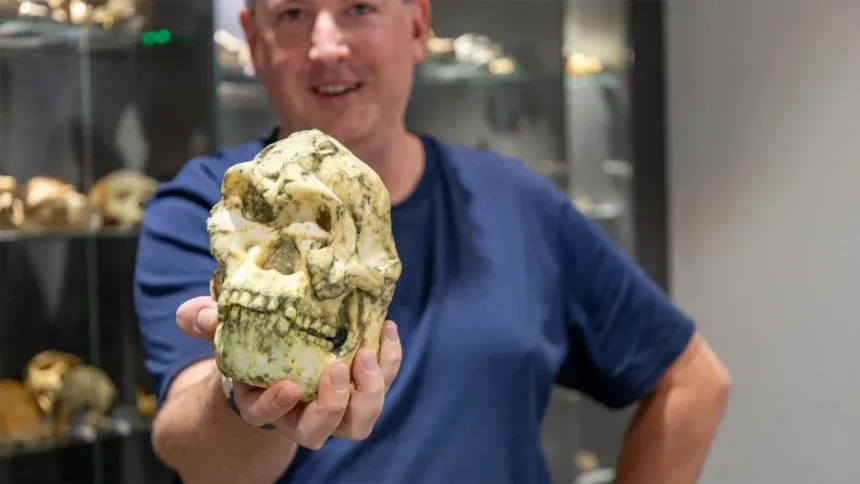
South Africa’s famed “Little Foot” fossil continues to reshape scientific understanding of early human evolution, offering one of the most complete glimpses yet into an ancient hominin that lived millions of years ago. Unearthed from the Sterkfontein Caves, the remarkably preserved skeleton has provided fresh insights into how early ancestors walked, climbed, and adapted to their environment. Recent research has refined its age and anatomical significance, reinforcing Africa’s central role in human origins. Beyond academia, the discovery carries cultural and scientific weight, positioning South Africa as a global hub for paleoanthropological research and heritage conservation.
Discovery and Historical Significance
The “Little Foot” fossil was discovered in the Sterkfontein cave system, part of a UNESCO World Heritage Site often referred to as the Cradle of Humankind. What sets this find apart is its extraordinary completeness, rare in the fossil record of early hominins. Unlike fragmentary remains that dominate the field, Little Foot provides a near-whole skeletal framework, allowing scientists to reconstruct posture, movement, and physical proportions with unusual precision.
Dating the Past with New Precision
Recent advances in dating techniques have helped researchers establish that Little Foot lived more than 3.5 million years ago. This places the fossil among the oldest known hominin skeletons ever found. The refined timeline challenges earlier assumptions that East Africa alone dominated early human evolution, strengthening evidence that southern Africa played a parallel and equally important role.
What the Bones Reveal About Early Life
Anatomical analysis suggests Little Foot was capable of upright walking while retaining features suited for climbing trees. This dual adaptation indicates a complex lifestyle, blending terrestrial movement with arboreal survival strategies. Such findings complicate simplistic narratives of linear evolution and instead point to a mosaic of traits shaped by diverse environmental pressures.
Scientific and Global Implications
For evolutionary science, Little Foot offers a benchmark for comparing other early hominin species. It has influenced debates over classification, biomechanics, and the pace of evolutionary change. On a broader level, the fossil enhances South Africa’s standing in global research networks, attracting international collaboration, funding, and academic tourism that contributes to the knowledge economy.
Preservation, Heritage, and Public Value
Safeguarding fossils of this magnitude requires sustained investment in conservation, research infrastructure, and public education. Institutions associated with the Little Foot discovery have emphasized balancing scientific access with heritage protection, ensuring the site remains a source of learning rather than exploitation.
Looking Ahead
As analytical techniques evolve, Little Foot is expected to yield further insights into humanity’s deep past. The fossil stands not only as a scientific treasure but also as a reminder that human origins are more geographically and biologically diverse than once believed—a story still being written, bone by bone, beneath African soil.
Comments