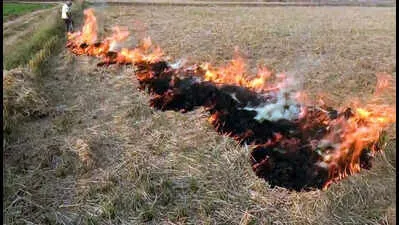
Punjab has reported a significant reduction in stubble-burning incidents this season, marking one of its most encouraging performances in recent years. While the state has historically been at the center of North India’s air pollution debate, current data shows that the number of farm fires in Punjab is substantially lower than the counts reported in Madhya Pradesh and Uttar Pradesh. This shift highlights the impact of policy interventions, increased mechanization, and farmer participation in sustainable residue management. The emerging trend also challenges widely held assumptions about Punjab’s role in seasonal pollution and brings renewed focus to broader agricultural practices across states.
A Remarkable Shift in Stubble-Burning Trends
Punjab, long criticized for being the epicenter of stubble burning in northern India, has recorded notably fewer farm fires this year. This decline marks a major departure from previous seasons when the state consistently topped the list of agricultural fire detections. Officials attribute the reduction to improved crop residue management, targeted government interventions, and greater adoption of in-situ handling techniques among farmers.
This year’s data reveals that Punjab’s count is not only lower than expected but also significantly below the numbers reported in Madhya Pradesh and Uttar Pradesh—two states that recorded comparatively higher farm fire instances.
Policy Measures and Administrative Push
Several targeted initiatives have contributed to the positive change. The state’s subsidy-backed distribution of mechanized equipment—such as Happy Seeders, straw choppers, and mulchers—has enabled farmers to clear fields without burning crop residue. Awareness drives, combined with stricter monitoring by district authorities, helped discourage the traditional practice of setting stubble ablaze.
Punjab authorities also coordinated with agricultural cooperatives and supported village-level programs that emphasized soil health and long-term economic gains from sustainable farming. This multi-tiered approach appears to have delivered measurable results.
Farmer Participation and Behavioral Change
A key factor behind Punjab’s success has been increased farmer participation. As more cultivators recognize the benefits of preserving soil nutrients and reducing long-term input costs, reliance on burning has gradually declined. Training sessions, field demonstrations, and financial incentives have accelerated this behavioral shift.
While constraints remain—particularly for small-scale farmers with limited resources—the overall willingness to adopt alternative methods reflects a growing awareness of environmental and economic consequences.
Comparative Performance: MP and UP Record Higher Fire Counts
In an unexpected twist, Madhya Pradesh and Uttar Pradesh have reported higher stubble-burning cases this season. Agricultural analysts suggest several reasons for this trend, including delayed harvesting cycles, limited access to mechanization, and uneven enforcement of residue management guidelines.
The comparative data places Punjab in a favorable position, challenging long-held narratives that singularly blame the state for seasonal deterioration in air quality across the northern plains.
Environmental and Economic Implications
The reduction in agricultural fires is not only an environmental milestone but also an economic opportunity for Punjab. Cleaner air contributes to improved public health outcomes and reduces the financial burden associated with pollution-related illnesses. At the same time, healthier soil resulting from residue retention can strengthen crop yields, enhance water conservation, and reduce fertilizer dependency.
If Punjab continues on this trajectory, the state could serve as a model for effective agricultural transition—balancing productivity with sustainability.
The Road Ahead
Despite encouraging progress, experts caution that the challenge is far from over. Consistency across years, sustained funding, and further expansion of residue management infrastructure will be essential to maintain momentum. Additionally, collaborative efforts between states, supported by central initiatives, are necessary to address region-wide pollution.
Punjab's current performance, however, is a noteworthy step toward transforming agricultural practices and reshaping the broader conversation around air quality in northern India.
Comments