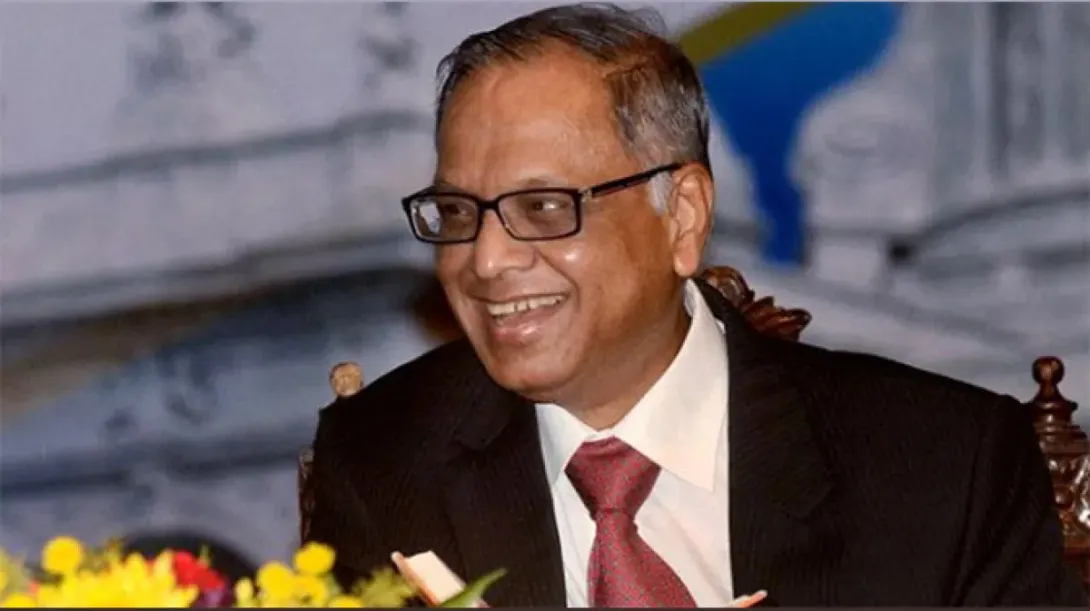
Infosys founder N.R. Narayana Murthy has called for India to prioritize research and innovation as a foundation for sustainable national progress. Speaking on the country’s developmental path, he emphasized that a research-driven culture—rooted in intellectual curiosity, scientific inquiry, and global collaboration—is essential to elevate India’s global standing. Murthy underscored the need for academic reforms, private sector involvement, and government support to strengthen India’s research ecosystem. He also urged young professionals and institutions to adopt a mindset of excellence, innovation, and integrity to propel India into the ranks of knowledge-driven economies.
India’s Future Lies in Knowledge and Innovation
Narayana Murthy, often described as the moral compass of India’s corporate sector, believes that India’s long-term success will depend less on its population size or natural resources and more on its ability to generate and apply knowledge.
“Research is the foundation of progress,” Murthy remarked, noting that innovation-driven economies such as the United States, Germany, and Japan have built their global leadership on decades of investment in science, technology, and human capital.
He pointed out that while India has made remarkable strides in digital transformation, infrastructure, and entrepreneurship, its investment in research and development (R&D) remains below 1% of GDP, significantly lower than the global average of 2.5% to 3%.
Bridging this gap, he argued, is vital for achieving India’s aspirations of becoming a developed economy by 2047, as envisioned by the government’s Viksit Bharat mission.
Strengthening India’s Research Ecosystem
Murthy emphasized that a robust research culture cannot emerge in isolation—it requires a synergistic partnership between academia, industry, and the state. Universities, he suggested, must go beyond rote learning and promote critical thinking, interdisciplinary collaboration, and global exposure.
He highlighted the importance of transforming Indian higher education into a platform for knowledge creation rather than knowledge consumption.
Murthy advocated for greater corporate participation in funding and facilitating innovation. Indian enterprises, particularly in sectors like IT, pharmaceuticals, and renewable energy, can play a catalytic role by creating research labs, sponsoring academic initiatives, and fostering start-up incubation ecosystems.
He also encouraged public-private partnerships (PPPs) to accelerate research in frontier areas such as artificial intelligence, biotechnology, green energy, and advanced manufacturing.
Education Reform as a Cornerstone
Central to Murthy’s vision is a comprehensive reform of India’s education system, which he believes should evolve from a rigid exam-centric model to one that encourages experimentation and curiosity. He noted that India’s demographic advantage—with over half of its population below 30—will be meaningful only if youth are equipped with the ability to think independently and solve complex problems.
To this end, he called for curriculum modernization, faculty development, and international collaborations between Indian universities and top global research institutions.
“True education is not about marks or degrees,” Murthy said, “it is about nurturing a mindset that constantly seeks better solutions.”
The Role of Industry in Driving Research
Murthy has long championed the role of industry in nation-building, particularly through responsible capitalism and innovation. He believes that Indian corporations must shift from being cost-efficient producers to knowledge-driven creators of global value.
By investing in R&D and promoting in-house innovation, Indian companies can help the nation move up the global value chain—from providing services to designing products and developing technologies.
He cited the Infosys experience as an example of how sustained investment in technology and people can transform a company into a global benchmark. Extending that logic to the national scale, Murthy said that every industry must view research as a long-term investment, not a short-term cost.
Building a Research-Oriented India
Murthy’s call for a research revolution aligns with India’s ongoing efforts to boost innovation and digital competitiveness. Government initiatives such as the National Research Foundation (NRF), Startup India, and Digital India aim to create a fertile environment for research-based enterprises.
However, he stressed that government policy alone is not enough. “The mindset change must come from within,” he said, urging Indian youth to embrace a culture of discipline, curiosity, and continuous learning.
He also highlighted that societal respect for scientists, teachers, and innovators must increase if India is to become a true knowledge economy.
“Only when we celebrate the pursuit of knowledge as much as wealth,” Murthy said, “will India realize its full potential.”
Outlook: From Aspiration to Action
Narayana Murthy’s message is as much a challenge as it is a vision—one that calls upon every stakeholder to contribute to India’s intellectual renaissance. With its vast talent pool, growing entrepreneurial ecosystem, and improving digital infrastructure, India stands well-positioned to lead the next global wave of innovation.
Yet, achieving that potential demands consistent investment in education, research, and ethics—the very pillars Murthy believes define a nation’s greatness. His vision of a research-led India is not just about technological advancement; it is about building a society that values knowledge, creativity, and collective progress.
Comments