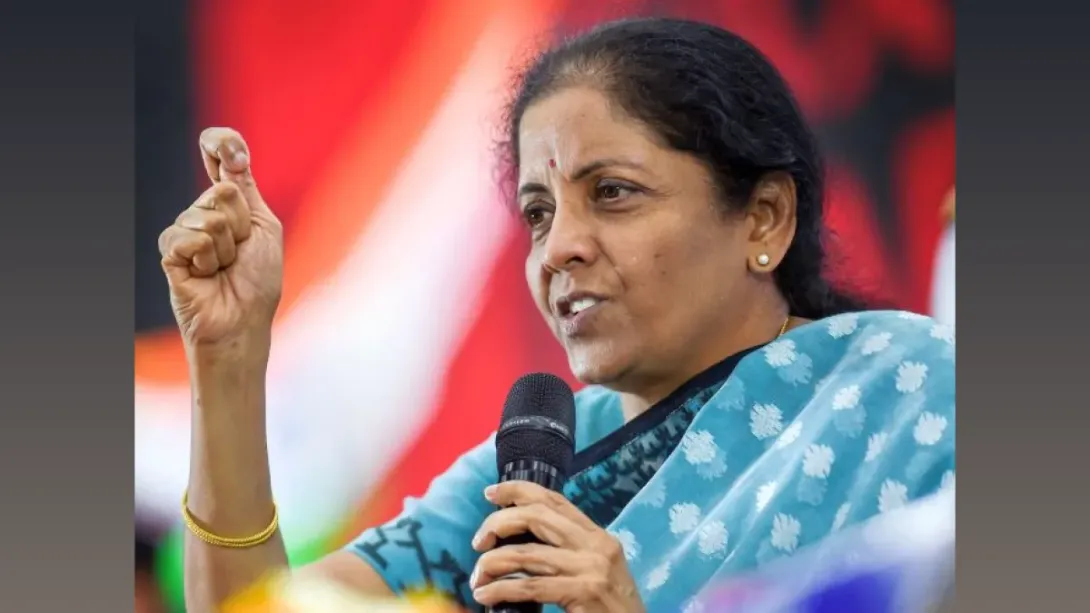
Finance Minister Nirmala Sitharaman reaffirmed India’s strong economic trajectory, stating that the nation is poised to emerge as the world’s third-largest economy in the coming years. Speaking at a recent event, Sitharaman emphasized India’s resilience amid global uncertainties and underscored the government’s commitment to sustaining growth through fiscal prudence, infrastructure expansion, and digital innovation. With consistent GDP growth, a stable macroeconomic framework, and expanding investment opportunities, India’s economic momentum is expected to outpace several major economies, strengthening its global influence and positioning it as a key driver of future economic transformation.
India’s Growth Momentum Gains Global Recognition
India’s rapid economic ascent has drawn widespread international attention, as the country continues to post strong growth rates despite global headwinds. According to Finance Minister Nirmala Sitharaman, India is firmly on the path to becoming the third-largest economy in the world, surpassing Japan and Germany within the next few years.
Addressing a gathering of industry leaders, Sitharaman highlighted that India’s consistent performance—driven by reforms in taxation, production-linked incentives (PLIs), and the expansion of digital infrastructure—has bolstered investor confidence and diversified the nation’s economic base. “The fundamentals of the Indian economy remain robust,” she said, emphasizing that the government’s policies are designed to foster sustainable and inclusive growth across sectors.
Macroeconomic Stability Anchored in Reforms
The Finance Minister attributed India’s steady economic progress to a series of structural reforms and disciplined fiscal management. Initiatives such as the Goods and Services Tax (GST), Insolvency and Bankruptcy Code (IBC), and targeted capital expenditure have strengthened the nation’s fiscal architecture.
Sitharaman noted that India’s fiscal deficit remains on a consolidation path, with the government striking a balance between supporting growth and maintaining financial discipline. The Centre’s focus on infrastructure spending—particularly in transportation, logistics, and energy—has created a multiplier effect on job creation and productivity.
Furthermore, the government’s push for ease of doing business and startup innovation has positioned India as a preferred investment destination in Asia. “India is no longer seen merely as a consumption hub, but as a production and innovation powerhouse,” Sitharaman asserted.
Digital Transformation Driving Efficiency
A major pillar of India’s economic success story has been its digital transformation, spearheaded by initiatives like Aadhaar, UPI, and the JAM trinity (Jan Dhan–Aadhaar–Mobile). Sitharaman emphasized that the digital public infrastructure has democratized financial access, improved efficiency in welfare delivery, and enhanced transparency in governance.
The widespread adoption of Unified Payments Interface (UPI) has not only revolutionized domestic transactions but also positioned India as a global model for low-cost, high-efficiency digital payments. The government’s efforts to promote financial literacy and rural digitization continue to bridge socio-economic divides, unlocking new avenues for entrepreneurship and small business growth.
Strengthening Global Competitiveness
Sitharaman highlighted India’s growing prominence in global supply chains as multinational corporations seek to diversify manufacturing bases. The ‘Make in India’ and PLI schemes have attracted significant foreign direct investment (FDI) in key sectors such as electronics, semiconductors, defense, and renewable energy.
India’s proactive trade diplomacy and participation in global economic forums have further reinforced its credibility as a stable and reform-driven economy. The Finance Minister underscored that India’s demographic dividend—bolstered by a young, skilled, and tech-savvy workforce—remains a core advantage in maintaining its competitive edge.
“India’s growth is not accidental; it is the outcome of sustained policy coherence, innovation, and institutional resilience,” she remarked.
Challenges Ahead: Balancing Growth with Equity
While optimism remains high, Sitharaman acknowledged that the path forward requires continued vigilance. Global challenges such as geopolitical tensions, commodity price volatility, and climate change pose potential risks. Domestically, ensuring equitable growth across regions and sectors remains a priority.
The government aims to strengthen rural employment, boost agricultural productivity, and expand renewable energy investments to achieve inclusive and sustainable development. Sitharaman reiterated that India’s growth must be both people-centric and future-oriented, ensuring that the benefits of progress reach every segment of society.
Outlook: A Decade of Opportunity
Economists project that India could achieve a nominal GDP of USD 5 trillion by 2027–28, overtaking major economies and cementing its position as a global growth leader. The nation’s expanding consumer base, technological innovation, and strategic geopolitical positioning offer immense potential for both domestic and foreign investors.
As Finance Minister Nirmala Sitharaman aptly concluded, “India’s story is one of resilience, reform, and reinvention. Our trajectory toward becoming the world’s third-largest economy is not just an aspiration—it is an achievable reality.”
Comments