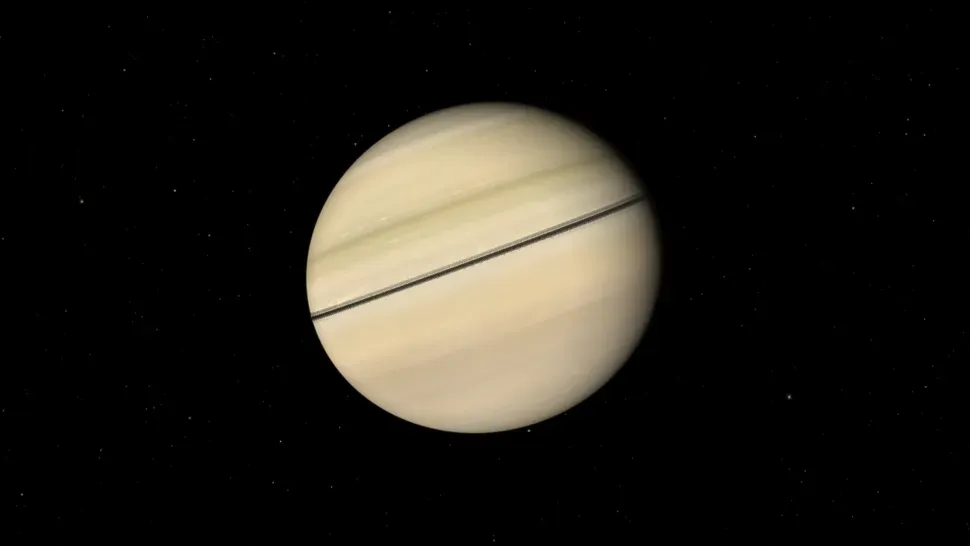
Saturn’s majestic rings, among the most recognizable features in the solar system, are entering a rare phase that makes them appear to vanish from view. NASA scientists explain that this phenomenon is not an actual loss of the rings but an optical illusion caused by the planet’s orbital position relative to Earth. As Saturn approaches its equinox, the rings tilt edge-on, making them nearly invisible through telescopes and space-based observatories. This transitional alignment, which occurs roughly every 15 years, offers astronomers a valuable opportunity to study the ring system’s structure, thickness, and dynamics with greater precision.
A Celestial Shift That Alters Saturn’s Appearance
Saturn’s visual transformation has captivated astronomers and space enthusiasts alike. Known for its expansive, gleaming ring system composed of ice, dust, and rock fragments, the gas giant is temporarily losing its iconic silhouette. The shift is not caused by any physical alteration of the rings but is instead a result of the planet’s natural orbital mechanics.
As Saturn orbits the Sun, the tilt of its ring plane changes relative to Earth. During equinox, the rings align perfectly edge-on from our vantage point, making them appear as a thin line—too narrow to be visible even through high-powered telescopes.
Why the Rings Seem to “Disappear”
NASA notes that the rings, which span hundreds of thousands of kilometers in diameter but are only about 10 meters thick in many regions, are incredibly delicate when viewed edge-on. This thinness causes sunlight to scatter differently, reducing their visibility.
When the rings face us at a steep angle, they reflect more sunlight and appear bright and expansive. As Saturn tilts away, the reflective surface area narrows dramatically. This results in the optical illusion of disappearance, despite the rings remaining fully intact.
The phenomenon is comparable to turning a sheet of paper sideways—its surface is still there, but nearly impossible to see.
A Rare Scientific Opportunity
While the optical shift may disappoint casual observers, scientists view the ring-plane crossing as a moment of exceptional scientific value. The alignment helps astronomers detect faint features otherwise hidden behind the planet’s bright disk.
During this period, researchers can:
- Study ring thickness and density variations
- Observe small moons embedded within the rings
- Track the movement of dust and ice particles with greater clarity
- Identify subtle gravitational interactions between Saturn and its ring materials
This alignment effectively turns the rings into an ultra-thin observational slit, enabling enhanced measurements that are difficult during periods of full illumination.
Historical Frequency and Future Viewing Prospects
Saturn’s ring-plane crossings occur roughly once every 15 years due to the planet’s 29.5-year orbital period. The last such crossing took place in 2009, and the next will happen in 2025, with Saturn gradually returning to a more visible ring tilt afterward.
For amateur stargazers hoping to observe the rings, visibility will remain limited until the tilt increases again, bringing the reflective icy particles back into view. By the late 2020s, Saturn’s rings will once again appear bright and expansive through telescopes from Earth.
Understanding the Illusion Enhances Appreciation
Though the temporary “disappearance” of Saturn’s rings may seem dramatic, it serves as a reminder of the dynamic, ever-changing nature of our solar system. The alignment highlights the delicate structure of the rings and underscores how perspective shapes our understanding of celestial bodies.
NASA’s explanation reinforces that the spectacle is purely visual—Saturn’s rings remain intact, continually interacting with sunlight, gravity, and space dust. As the planet moves beyond equinox, the familiar beauty of the ringed giant will reemerge, offering observers a renewed view of one of astronomy’s most iconic sights.
Comments