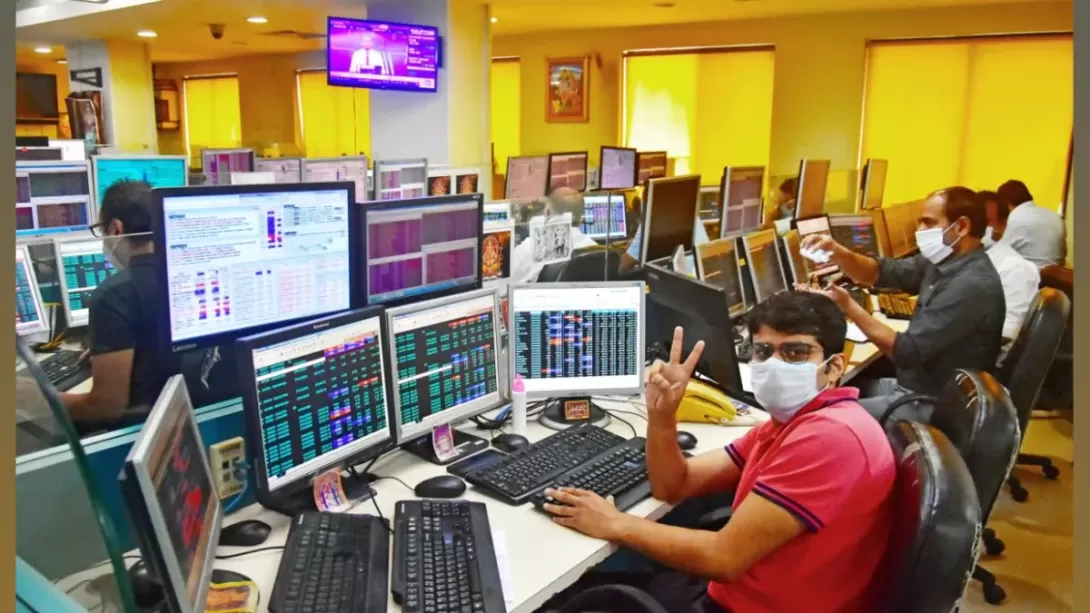
Indian equity markets staged a sharp recovery on Monday, driven by value buying in information technology and energy stocks, coupled with a positive global sentiment and easing crude oil prices. The benchmark BSE Sensex soared 677 points to close at 81,796.15, while the NSE Nifty advanced nearly 228 points to end at 24,946.50. This rebound comes on the heels of a two-session losing streak, during which both indices shed close to 1.7%. Key gainers included large-cap IT firms and cement majors, while subdued performance was noted in auto and pharma counters. Meanwhile, global equity indices largely traded in the green as Brent crude eased below USD 74.
Indices Regain Ground After Two-Day Slide
After two sessions of sharp declines that saw the Sensex and Nifty lose nearly 1.7%, Indian equities rebounded strongly on Monday. The 30-share BSE Sensex rose 677.55 points, or 0.84%, to close at 81,796.15. In intraday trade, the index gained as much as 747.22 points to touch 81,865.82. Meanwhile, the broader NSE Nifty climbed 227.90 points, or 0.92%, to settle at 24,946.50.
The resurgence was largely supported by strong buying interest in heavyweight IT stocks and energy firms. Investor sentiment was buoyed by a broader global market rally and a softening of crude oil prices, which helped offset recent bearish pressure from foreign capital outflows and geopolitical uncertainty.
IT and Cement Lead Gains; Select Stocks Lag
Among the 30 constituents of the Sensex, the top gainers included UltraTech Cement, Tech Mahindra, HCL Technologies, Tata Consultancy Services, Asian Paints, Tata Steel, and Kotak Mahindra Bank. These stocks benefited from a combination of value-driven buying, sectoral rotation, and expectations of margin stability amid falling input costs.
On the downside, Tata Motors, Adani Ports, and Sun Pharma were among the few laggards, reflecting profit-booking and muted sentiment in auto and pharma counters after recent outperformance.
Global Cues and Brent Crude Decline Bolster Sentiment
Investor confidence was further lifted by a broad rally in Asian equities, with South Korea’s Kospi, Japan’s Nikkei 225, China’s Shanghai Composite, and Hong Kong’s Hang Seng ending in positive territory. European equities were also trading higher during Indian market hours, signaling risk-on sentiment across global markets.
Brent crude oil prices fell by 0.81% to USD 73.63 per barrel, offering relief to oil-importing economies such as India. The decline in energy prices is seen as a potential catalyst for improved corporate profitability and a lower inflation trajectory.
Inflation Eases as WPI Falls to 14-Month Low
Adding to the positive domestic narrative, India's wholesale price index (WPI) inflation dropped to 0.39% in May, marking a 14-month low. The moderation was primarily attributed to cooling prices of food articles and fuel. Lower wholesale inflation is generally seen as a precursor to subdued retail price pressure, which could give the Reserve Bank of India more flexibility in its monetary stance.
Institutional Activity Remains Mixed Amid Volatility
Despite the market rebound, foreign institutional investors (FIIs) remained net sellers, offloading equities worth Rs. 1,263.52 crore on Friday, as per exchange data. This follows a broader trend of cautious foreign inflows in the face of global geopolitical uncertainties, particularly those emanating from the Middle East.
The sharp gains on Monday, therefore, were primarily driven by domestic institutional buying and retail participation, signaling robust local investor confidence even amid external headwinds.
Conclusion: Cautious Optimism with Global Undercurrents
While Monday’s rebound underscores the resilience of Indian equity markets, analysts caution that volatility may persist in the near term. Geopolitical tensions, interest rate expectations in advanced economies, and the trajectory of oil prices remain key variables. Nonetheless, the combination of strong domestic fundamentals, softening inflation, and robust sectoral performance—especially in IT and infrastructure—continues to offer investors a favorable medium-term outlook.
In the current environment, investors are advised to remain selectively bullish while maintaining a disciplined approach to risk management.
Comments