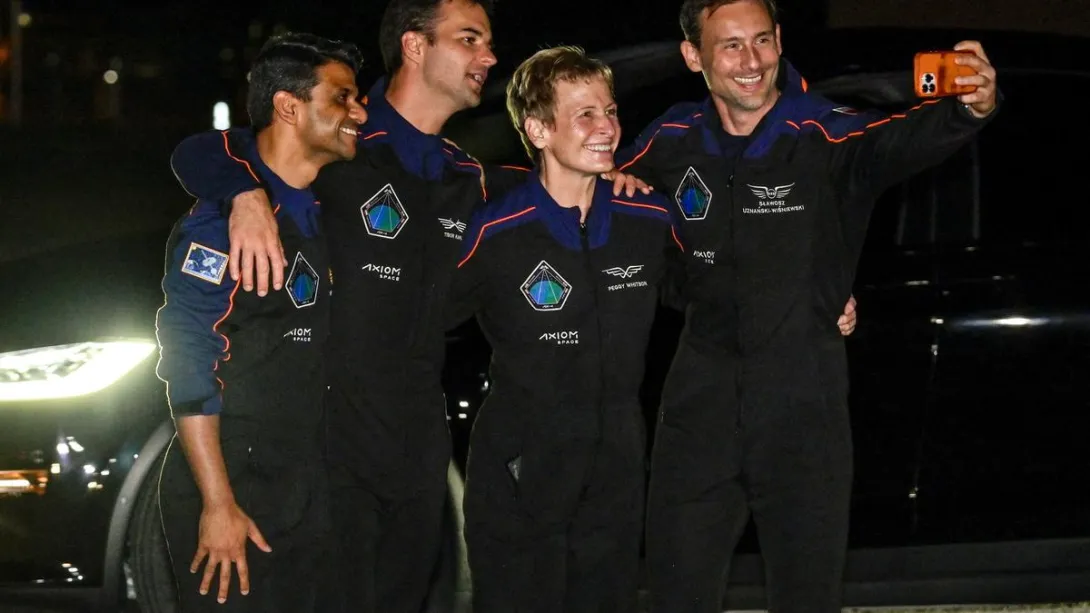
Indian Air Force Group Captain Shubhanshu Shukla has successfully docked at the International Space Station (ISS) aboard SpaceX’s Dragon capsule as part of the Axiom 4 mission. Alongside international crewmates, Shukla will engage in critical scientific research during a 14-day stay in orbit. Expressing pride in representing India and a sense of lightheadedness due to the microgravity environment, the astronaut marks a significant milestone in India’s space exploration journey. The mission carries symbolic and scientific significance, underlining growing international cooperation and private sector participation in space ventures.
Successful Docking and Historic Arrival
On June 26, 2025, Group Captain Shubhanshu Shukla, an Indian Air Force pilot turned astronaut, achieved a landmark moment by docking the SpaceX Dragon spacecraft "Grace" with the International Space Station (ISS). This marked the culmination of meticulous planning and training, resulting in the first-ever Indian Air Force astronaut joining the elite cadre of space explorers. Accompanied by Slawosz Uznanski-Wisniewski of Poland, Tibor Kapu of Hungary, and mission commander Dr. Peggy Whitson of the United States, Shukla joined a multinational team poised to undertake vital scientific endeavors over the next two weeks.
The docking, broadcast live and watched by Shukla’s family, friends, and admirers—including a poignant moment where his mother was seen emotional—signified not only a personal achievement but also an inspiring moment for India’s aerospace ambitions. The capsule, part of SpaceX’s Axiom 4 mission and the fifth and final Dragon in Elon Musk’s fleet, underscores the growing role of private enterprises in human spaceflight.
A Mission of Science and National Pride
Group Captain Shukla candidly described feeling "lightheaded," a common effect of microgravity, yet emphasized that his excitement about the scientific tasks ahead far outweighed any discomfort. The astronaut expressed deep pride in representing India, noting, "I wear the tricolour on my shoulders with pride." His remarks resonate with a generation of Indian youth aspiring to contribute to space exploration and reflect India’s increasing footprint in global aerospace endeavors.
The crew’s 14-day stay aboard the ISS will focus on a variety of experiments spanning fields such as materials science, biology, and environmental studies—critical research that can advance technologies on Earth and future space missions. Shukla’s participation also symbolizes a growing trend toward international cooperation, with astronauts from diverse nations collaborating seamlessly in orbit.
Family and Public Celebrations Back Home
Back in Lucknow, where Group Captain Shukla attended school, his family and well-wishers gathered to watch the live telecast of the docking event. His father, Shambhu Dayal Shukla, expressed overwhelming pride and gratitude, announcing plans to meet Uttar Pradesh Chief Minister Yogi Adityanath in recognition of this historic feat. This event marks a powerful moment of inspiration for aspiring scientists, engineers, and aviators across India, reinforcing the importance of sustained investment in STEM education and aerospace capabilities.
The Broader Context: Private Sector and India’s Space Ambitions
The Axiom 4 mission highlights how private-sector companies like SpaceX are revolutionizing access to space, lowering costs, and expanding opportunities for international astronauts. As India pursues its space exploration goals, including lunar missions and potential human spaceflight programs, collaborations with global partners and commercial entities are increasingly crucial.
Group Captain Shukla’s journey exemplifies a successful confluence of military discipline, scientific endeavor, and private-public partnerships in aerospace innovation. His mission is a harbinger of India's emerging role in the global space economy, which is projected to exceed Rs. 20 trillion ($250 billion) by 2030, fueled by satellite deployments, space research, and space-based services.
Conclusion
Group Captain Shubhanshu Shukla’s successful docking and forthcoming scientific work aboard the ISS signal a transformative moment for India’s aerospace sector. Combining international collaboration, private enterprise involvement, and national pride, this mission showcases the evolving dynamics of space exploration in the 21st century. As India moves closer to realizing its space ambitions, such milestones inspire continued innovation, research, and investment—essential ingredients for carving a significant presence beyond Earth’s atmosphere.
Comments