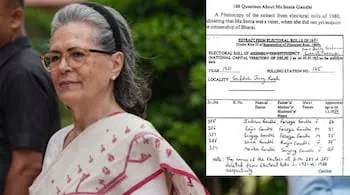
The Bharatiya Janata Party (BJP) has reignited scrutiny over Sonia Gandhi’s electoral eligibility, presenting copies of the 1980 electoral rolls that reportedly list her as a registered voter in India despite her Italian citizenship. Party leaders argue that this raises questions about the integrity of voter registration processes and compliance with legal requirements for foreign nationals. The development underscores ongoing political disputes over electoral documentation and transparency. While the Congress party has dismissed the claims as politically motivated, the issue has intensified discussions about electoral oversight, citizenship, and the legal framework governing voting rights in India.
BJP Highlights Historical Electoral Records
BJP officials presented archival electoral documents from 1980, highlighting Sonia Gandhi’s inclusion as a registered voter. The party contends that the listing predates her Italian citizenship declaration, framing it as a potential inconsistency with the Representation of the People Act, which prohibits foreign nationals from registering as voters.
This move is part of a broader strategy by the BJP to question the procedural integrity of electoral records and to spotlight what it describes as systemic lapses in enforcement and verification.
Congress Responds to Allegations
The Congress party has categorically denied any wrongdoing, emphasizing that Sonia Gandhi’s voter registration occurred decades ago and that all legal requirements have been met subsequently. Party officials criticized the BJP for politicizing historical records, suggesting that the focus on archival documentation distracts from substantive governance issues.
Analysts note that while historical electoral records can provide insight into procedural anomalies, they often reflect administrative practices of the era and may not indicate intentional misconduct.
Legal and Electoral Implications
The controversy raises broader questions about voter registration, citizenship verification, and the mechanisms in place to ensure compliance with electoral laws. Legal experts point out that inclusion of foreign nationals in electoral rolls, if verified, could constitute a violation of the Representation of the People Act. However, establishing accountability decades after the fact involves complex statutory and procedural considerations.
The case also highlights the importance of maintaining accurate, transparent, and regularly updated electoral rolls to safeguard democratic processes and prevent disputes over voter legitimacy.
Political and Public Impact
The BJP’s focus on historical voter records appears designed to influence public discourse ahead of upcoming elections, leveraging concerns about electoral integrity to rally support. Meanwhile, Congress emphasizes the importance of focusing on contemporary governance challenges rather than retrospective scrutiny.
The debate underscores a persistent tension in Indian politics between historical documentation, legal compliance, and the strategic use of information for political gain. Observers suggest that the controversy could intensify scrutiny of electoral procedures and stimulate calls for more rigorous verification mechanisms.
Conclusion
The ongoing dispute over Sonia Gandhi’s historical voter registration illustrates the interplay of law, politics, and public perception in India’s electoral landscape. As parties navigate these contentious issues, the case highlights the enduring need for transparency, accountability, and robust institutional oversight to ensure confidence in democratic processes.
Comments