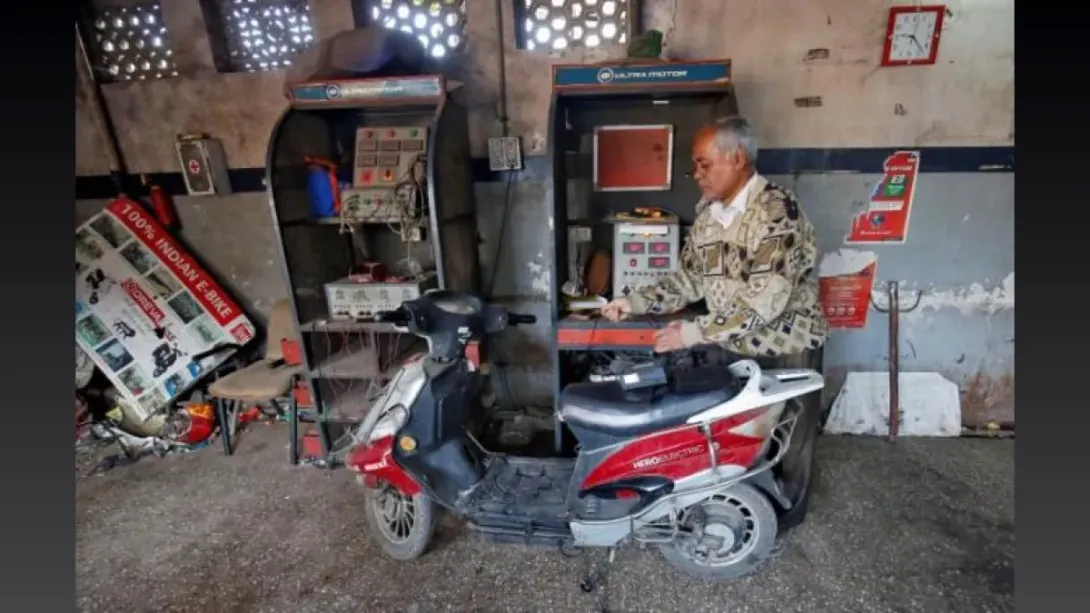
India’s Production-Linked Incentive (PLI) scheme for the automobile sector is materially reshaping the electric two-wheeler (e2W) ecosystem, accelerating domestic manufacturing, boosting localization and enhancing export competitiveness. By linking fiscal incentives to incremental output and advanced technology adoption, the policy has catalyzed capital investment across battery manufacturing, power electronics and vehicle assembly. Industry data indicate stronger supply-chain integration and improved economies of scale, positioning Indian manufacturers to compete globally. As international demand for affordable electric mobility intensifies, the scheme is emerging as a cornerstone of India’s strategy to transition from a consumption-driven market to a globally relevant electric vehicle production hub.
Understanding the Auto PLI Framework
The Government of India introduced the Auto PLI scheme to incentivize incremental production of advanced automotive technologies and high-efficiency vehicles. The program allocates financial incentives to manufacturers based on predefined investment thresholds and production targets, thereby aligning fiscal support with measurable output growth.
Unlike traditional subsidy models, the PLI mechanism rewards scale, innovation and localization. For electric two-wheelers—an increasingly dominant segment within India’s mobility landscape—the policy has provided a structured pathway for capital infusion and technology upgrading.
Industry analysts observe that the scheme has encouraged both established automotive players and emerging electric mobility startups to expand capacity and integrate vertically.
Catalyzing Growth in the Electric Two-Wheeler Segment
India’s electric two-wheeler market has witnessed rapid expansion, driven by rising fuel costs, urban congestion and environmental considerations. The Auto PLI scheme has reinforced this growth by lowering effective production costs for manufacturers that meet localization and performance criteria.
The e2W segment is particularly significant because two-wheelers account for the majority of India’s vehicle population. Transitioning even a fraction of this base to electric platforms offers substantial environmental and economic benefits.
Manufacturers participating in the scheme have accelerated investments in battery assembly units, motor technology and electronic control systems. As scale improves, per-unit production costs are expected to decline, enhancing affordability for consumers.
Strengthening Localization and Supply Chains
One of the central objectives of the PLI framework is to reduce dependence on imported components, particularly advanced battery cells and semiconductor-based systems. By incentivizing domestic value addition, the scheme aims to create a resilient and self-sustaining supply chain.
Industry executives report increasing localization levels in battery packs, chassis components and drivetrain assemblies. This not only mitigates currency volatility risks but also shortens supply cycles and improves quality oversight.
From a macroeconomic standpoint, higher localization translates into job creation, technology transfer and stronger industrial capacity—key pillars of long-term manufacturing competitiveness.
Export Opportunities Gain Momentum
Beyond domestic demand stimulation, the Auto PLI scheme is gradually enhancing India’s export prospects in the electric mobility space. Competitive production costs, combined with policy-backed scale, position Indian manufacturers to serve price-sensitive markets in Asia, Africa and Latin America.
Global demand for electric two-wheelers is expanding, particularly in regions with dense urban populations and rising fuel prices. Indian firms, leveraging cost advantages and engineering expertise, are increasingly exploring overseas distribution partnerships.
Trade analysts suggest that as production volumes rise and quality benchmarks align with international standards, exports could become a significant revenue contributor for leading e2W manufacturers.
Capital Allocation and Industry Consolidation
The incentive structure has also influenced capital allocation strategies within the sector. Companies are prioritizing long-term investments in research and development, battery chemistry improvements and digital integration.
However, the scheme’s performance-linked criteria may accelerate consolidation. Smaller players lacking capital strength could face challenges in meeting investment thresholds, potentially leading to mergers or strategic alliances.
While competition remains intense, the overall industry structure is gradually shifting toward scale-driven efficiency and technological differentiation.
Long-Term Economic and Environmental Implications
The Auto PLI scheme represents more than a fiscal incentive; it embodies a strategic industrial policy designed to future-proof India’s automotive sector. By aligning financial rewards with sustainability goals, the government has created a framework that integrates environmental stewardship with economic expansion.
As electric two-wheelers gain traction domestically and internationally, the scheme’s success will ultimately be measured by sustained output growth, export penetration and technological innovation.
For investors and policymakers alike, the evolving impact of the Auto PLI initiative signals a broader transformation—one in which India seeks not merely to participate in the global electric mobility revolution, but to help define it.
Comments