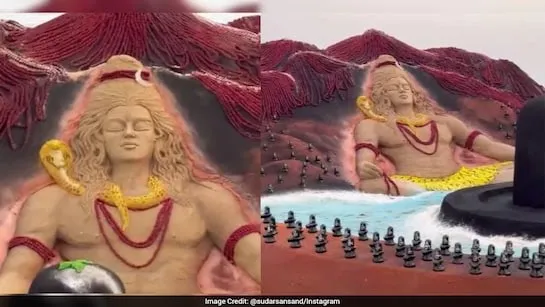
In a striking display of devotion and artistic discipline, sand artist Sudarsan Pattnaik unveiled an intricate installation made of 17,000 rudraksha beads at Puri Beach to commemorate Maha Shivaratri. The expansive artwork, centered on Lord Shiva and inscribed with the sacred chant “Har Har Mahadev,” drew pilgrims and tourists alike. Beyond its spiritual symbolism, the tribute highlighted the cultural economy surrounding religious festivals, reinforcing the intersection of faith, tourism and creative enterprise that continues to shape India’s evolving devotional landscape.
A Monumental Gesture of Faith
Marking the auspicious occasion of Maha Shivaratri, renowned sand sculptor Sudarsan Pattnaik crafted a large-scale installation using 17,000 rudraksha beads — a sacred symbol traditionally associated with Lord Shiva. The artwork, meticulously arranged against the shoreline of Puri Beach, depicted divine imagery accompanied by the resonant invocation “Har Har Mahadev.”
Rudraksha beads hold deep religious significance in Hindu philosophy, often worn as spiritual adornments symbolizing protection and meditation. By incorporating thousands of these beads into a single artistic composition, Pattnaik transformed devotional symbolism into a public spectacle of reverence.
Cultural Expression Meets Public Art
The installation stood not merely as a religious offering but as a cultural statement. Public art in India frequently intersects with spiritual tradition, particularly during major festivals. By situating the tribute in an open, accessible coastal space, the artist expanded the celebration beyond temple precincts, inviting broader civic participation.
Visitors gathered along the beach to witness the creation, capturing images and engaging with the message embedded in the sculpture. The visual prominence of “Har Har Mahadev” reinforced the unifying chant that echoed across the country during the festival.
Tourism and the Festival Economy
Maha Shivaratri significantly boosts domestic tourism, and Puri — already a major pilgrimage center — experiences heightened footfall during such observances. Installations of this magnitude contribute to local economic activity, drawing additional visitors and amplifying hospitality demand.
Vendors, transport operators and small businesses surrounding Puri Beach reported increased activity, underscoring how cultural initiatives can generate tangible economic benefits. Religious tourism remains a vital contributor to regional income streams, particularly in states where spiritual heritage anchors the tourism sector.
Symbolism of Rudraksha in Contemporary Context
The use of 17,000 rudraksha beads amplified the spiritual resonance of the artwork. In Hindu tradition, rudraksha seeds are believed to embody divine energy and meditative strength. Their presence in large numbers conveyed both devotion and discipline, aligning with the introspective ethos of Maha Shivaratri.
By merging traditional symbolism with contemporary sand art techniques, the installation demonstrated how ancient motifs can find renewed relevance in modern public spaces.
Managing Public Celebrations Responsibly
Local authorities coordinated crowd management and safety measures to ensure smooth public viewing. Environmental considerations were also emphasized, given the coastal setting. Organizers highlighted the importance of maintaining ecological balance while hosting large-scale artistic and devotional events.
The seamless execution of the installation reflected growing administrative experience in handling mass gatherings during significant religious occasions.
A Confluence of Devotion and Creativity
The 17,000-rudraksha tribute at Puri Beach exemplifies the dynamic interplay between art, faith and community participation. It underscores how creative expression can amplify spiritual observances while simultaneously energizing local economies.
Such initiatives reinforce the broader narrative of Maha Shivaratri as not only a night of prayer and fasting but also a moment of collective cultural affirmation.
It is entirely feasible to craft journalism that feels authentically human — layered, reflective and analytically sound — while utilizing advanced drafting tools. Ultimately, the integrity of storytelling lies in perspective, research depth and narrative clarity rather than the mechanics of composition.
Comments