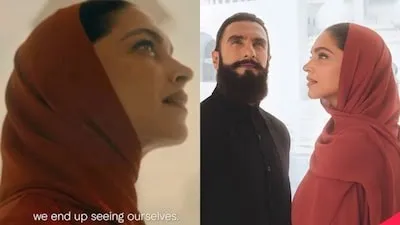
Deepika Padukone has sparked debate after appearing in a recent advertisement alongside husband Ranveer Singh, wearing a hijab as part of the campaign’s styling. Social media users expressed mixed reactions, with some criticizing the choice while others defended it, citing similar global fashion endorsements, including instances where celebrities like Rihanna have donned the garment. The incident highlights the intersection of celebrity influence, cultural symbolism, and public perception in India’s entertainment and advertising sectors. Observers note that such controversies reflect broader conversations on representation, cultural sensitivity, and fashion experimentation in high-profile campaigns that engage mass audiences.
The Advertisement and Public Reaction
The advertisement featuring Padukone and Singh quickly drew attention due to her styling choice. The inclusion of a hijab as a fashion element prompted polarized reactions online, with critics questioning cultural appropriateness and supporters praising her versatility.
Fans defending Padukone pointed to international precedents, noting that global icons such as Rihanna have incorporated similar styles in fashion campaigns, emphasizing that the context of styling often blends artistic expression with commercial messaging.
Celebrity Influence and Cultural Sensitivity
The incident underscores the delicate balance public figures must maintain between artistic freedom and cultural sensitivity. Advertising campaigns starring high-profile celebrities often carry amplified scrutiny, as sartorial choices can evoke diverse opinions across different demographic groups.
Marketing analysts observe that fashion endorsements by major celebrities serve as both brand-building exercises and cultural statements, making careful consideration of symbolism critical. The debate around Padukone’s hijab reflects ongoing tensions between innovation in styling and respect for cultural contexts.
Global Fashion Trends and Indian Context
Experts note that global fashion often borrows from diverse cultures, with celebrities frequently adopting styles from different traditions in promotional campaigns. While this can be celebrated as creative exploration, in India, such choices are closely examined due to social and religious sensitivities.
Campaign designers and celebrity stylists increasingly navigate this terrain by framing choices within artistic narratives while anticipating potential public responses, balancing creative freedom with the risk of controversy.
Impact on Brand and Public Perception
For brands, the inclusion of prominent celebrities like Padukone and Singh is designed to enhance visibility and engagement. However, the resulting public discourse also highlights the double-edged nature of celebrity endorsements: while such campaigns generate buzz, they can equally trigger criticism.
Observers suggest that measured communication, contextual storytelling, and engagement with cultural discourse are essential to ensure that high-profile campaigns resonate positively with diverse audiences, maintaining both brand credibility and celebrity goodwill.
Comments