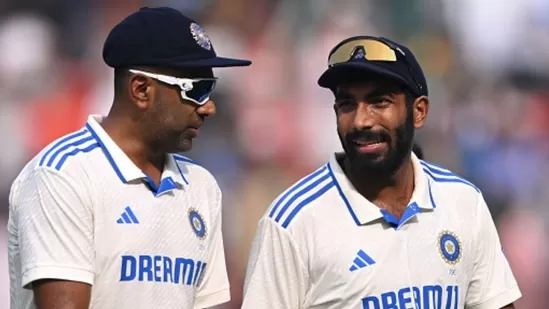
As India prepares for a grueling five-Test series against England, former spinner Ravichandran Ashwin has issued a timely warning about the risks of mismanaging fast-bowling spearhead Jasprit Bumrah. Speaking from Chennai, Ashwin underscored the importance of deploying sports science and objective data to monitor Bumrah’s workload, rather than relying on subjective assessments. His cautionary tale draws from the 2020-21 Australia series, where overuse led to Bumrah’s injury and India’s missed opportunity. With key bowlers absent and pressure mounting, India’s success in England could hinge not just on talent—but on how scientifically they manage Bumrah’s physical condition.
The Stakes in England: A Cautionary Tale
India's tour of England is no ordinary series. A five-match Test contest in challenging conditions demands not only skill and strategy but precise workload management—especially for pace bowlers. Without Mohammed Shami and Ravichandran Ashwin in the squad, Jasprit Bumrah stands as the undisputed leader of India’s fast-bowling unit. However, his history of back injuries has made him a case study in the perils of overuse.
Ashwin, who retired from international cricket in December, has sounded the alarm. His message to team management, including head coach Gautam Gambhir and star batter Shubman Gill, is clear: mishandling Bumrah could derail India’s campaign—and again cost them dearly.
A Lesson from the Past: The Australia Example
Reflecting on India’s 2020-21 tour of Australia, Ashwin pointed out how India failed to preempt Bumrah’s physical limits. Despite concerns emerging after the Melbourne Test, Bumrah continued through the series until a breakdown during the Sydney Test sidelined him for months. That not only hurt India’s immediate campaign but also forced him out of the subsequent Champions Trophy, where India emerged victorious—without their frontline pacer.
"Back then, decisions were made reactively," Ashwin said. “Jassi said he felt tired only after Melbourne. By Sydney, it was too late.”
This hindsight, Ashwin argues, should serve as foresight now.
Objective Over Subjective: Bring in Sports Science
Ashwin’s central criticism lies in India’s underutilization of modern sports science. While global teams have embraced performance analytics and biometric tracking, India still appears to rely heavily on subjective feedback from players.
Ashwin emphasized the need for daily tracking of Bumrah’s physical parameters—ranging from heart rate variability and muscle recovery to acceleration speeds during training and matches. Such data, when cross-referenced with how a player feels, allows for precise intervention.
“You can’t just guess if he’s ready or not. If his markers drop after two Tests, give him a break—even if he says he’s fine,” Ashwin insisted.
Strategic Rotation: Beyond a Fixed Schedule
Much debate surrounds how many matches Bumrah should play in this five-Test series. Should it be two? Three? All five? Ashwin argues that instead of fixing a pre-determined number, management must remain flexible and guided by real-time monitoring.
“You don't have to decide today whether he plays at Edgbaston or not. Wait, measure, evaluate, and decide. That’s how elite teams work,” he noted.
The lack of such an approach previously cost India both matches and manpower. Ashwin fears repeating those mistakes could compromise India's shot at a historic Test series victory in England.
Managing Bumrah: High Stakes, Higher Standards
Bumrah is not just a bowler—he’s a match-winner. His performance can tilt the balance in a closely contested Test. Ashwin was quick to highlight that had Bumrah been available in Sydney during the Australia series, India might have defended a modest total and squared the series 2-2.
“Such moments define careers—and series,” he said. “If he breaks down again, the cost could be immense, not just for this series, but for the broader calendar.”
The Bigger Picture: Building a Culture of Precision
Ashwin’s observations go beyond Bumrah—they touch upon a systemic gap in India’s approach to player fitness and longevity. His push for data-led decision-making is a clarion call for the Board of Control for Cricket in India (BCCI) to institutionalize sports science into mainstream strategy.
With the 2026 Champions Trophy and the next WTC cycle looming, India cannot afford another high-profile injury to a player as irreplaceable as Bumrah.
Comments